Ao Nang to Railay by Longtail: Tides, Wading and Your Suitcase.
A booth, a boat that waits to fill, and a few steps through the sea at each end.
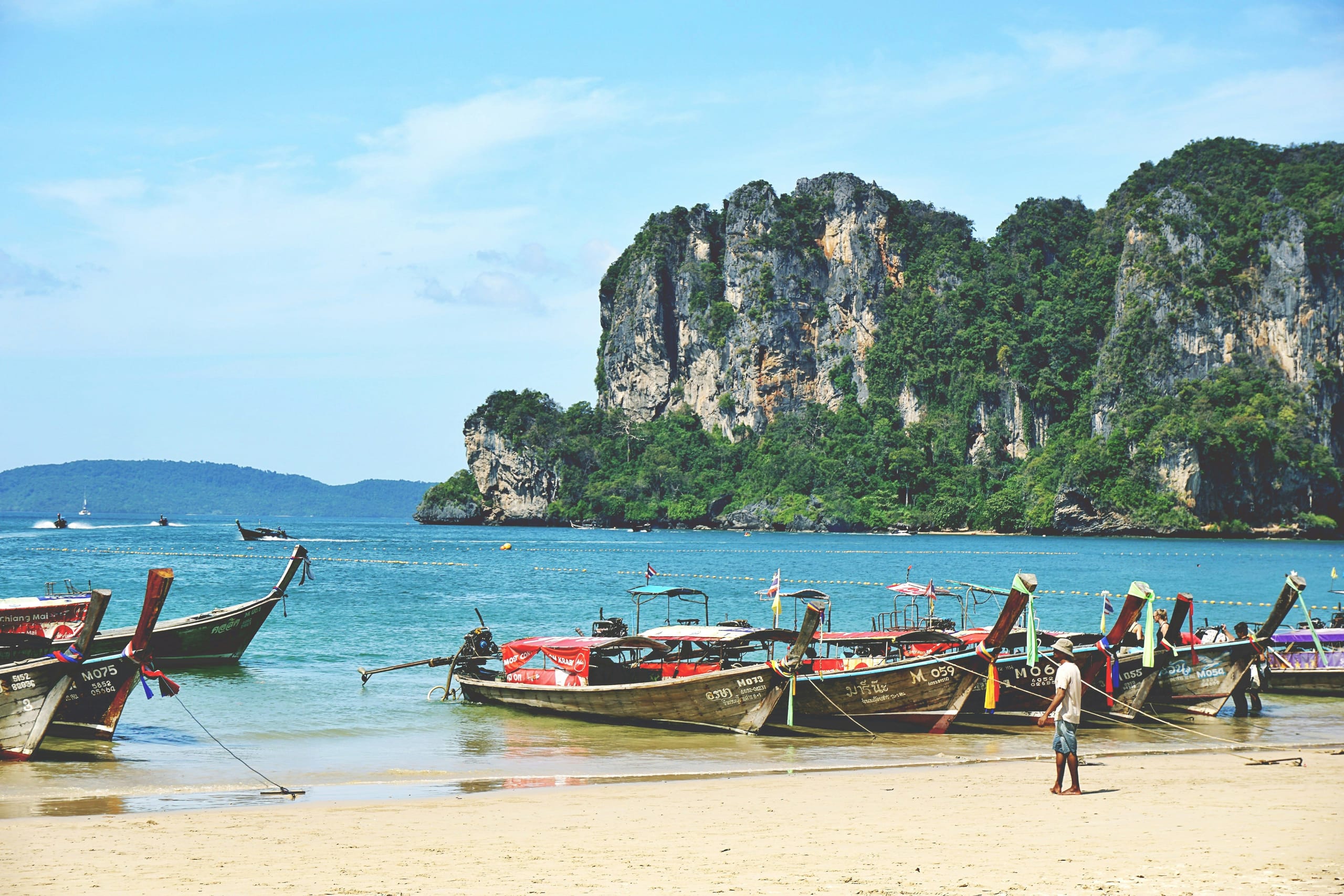
The boat is already in the water when you reach it, nose toward the sand, engine off, lifting a little each time a wave slides in under the hull. The man at the back waves you forward. Between you and the boat there are about 30 feet (9 m) of sea.
You are holding a suitcase. It has wheels. They are not going to help.
Railay sits a short ride south of Ao Nang, on a peninsula the cliffs cut off from any road, so everyone who stays there arrives the same way: in a longtail, through the shallows, with their bags held up out of the water. None of it is hard. It is wetter than the booking page suggested, and the tide decides how much wetter.
The short version
TL;DR
- Buy a one-way seat at a longtail ticket booth on the Ao Nang beachfront, in cash. Boats run from about 8 in the morning to 6 in the evening and leave when they fill.
- The ride takes 10 to 15 minutes. Boats from Ao Nang land on Railay West unless you ask for somewhere else, and you step off into the sea.
- On a low tide or a choppy sea, the boats can leave from Nopparat Thara pier instead, with a transfer from the booth included.
- Cross with a backpack or a bag you can lift to your chest. Wheels do nothing on wet sand.
The booth on the beach road
If you have just come in on the ride from Krabi airport, you already know the beach road: hotels and tour desks on one side, sand on the other. The Railay boats are sold from that same strip.
There are 2 official ticket points, one toward each end of the beachfront. The one most guides send you to is the Ao Nang Longtail Boat Service Club, which is the busier of the 2, and busy is exactly what you want, because a busy booth fills a boat faster. Booths take cash only. Tell them where you are going, pay, and wait for someone to shout Railay.
"The reason I recommend this end is that it is much more popular and as a result, boats fill up quickly so that you don't have to wait."
The boats keep no timetable. They run on arithmetic. A longtail will sit on the sand until it has enough passengers to make the trip worth the fuel, and it has far more patience than you do. Guides that have counted put the number at 6, at 8, or at about 9, depending on the day and the booth. Call it a boatload.
If you are in a hurry, or it is 5:40 and the beach is empty, you can buy the empty seats yourself and leave now. Ask the booth what that comes to before you agree.
When to go
The shared boats run from about 8 in the morning to 6 in the evening. Mid-morning, around 9 and 10, is when they fill fastest. Low season is the opposite, and a slow hour means a long wait on the sand while the boat waits too.
After 6 the shared boats stop. A private longtail will still take you, at a price you settle before anyone starts the engine, and it is precisely the kind of small unplanned cost a trip budget forgets to include.
The boat leaves when it is full. Full is a number the boatman knows and you do not.
Getting into the boat
Scene
9 in the morning on the Ao Nang beachfront. A boatman sits on the bow of his longtail with his feet in the water. 4 people with backpacks wait in the shade by the booth. A fifth arrives pulling a suitcase, and everyone looks at it kindly, the way you look at someone who is about to learn something.
Definition
Wet landing Getting on or off a boat by stepping into the sea, because there is no pier and the boat cannot reach dry sand.
On the Ao Nang to Railay West run, plan on one at each end.
There is no pier for these boats at Ao Nang. The longtail noses into the shallows and you walk out to it. At high tide the walk is short, the water comes to about your knees, and you climb in over the side.
"If it’s high tide, you’ll get wet up to about your knees before you can climb on board. The same thing happens at Railay Beach."
At low tide the sea pulls back and leaves a wide band of wet sand, and the boats wait at the far edge of it. Now the walk is long, the sand is ridged, and the last stretch can cross slippery rock pools. Bare feet are fine on sand. On rock they are not.
The usual first plan is to wear sneakers, take them off at the waterline and carry them. This leaves you with shoes in one hand, a bag in the other, and no hand at all for the boat, which is the only thing in the scene that refuses to keep still. Water shoes or sandals with a back strap solve it. So does wading in whatever you would swim in.
What the tide does
This coast gets 2 high tides and 2 low tides on most days, and the gap between them is not small. Around the new and full moon the sea here can rise and fall nearly 8 feet (2.4 m) between a low and the next high. That is the difference between a short step and a long walk.
The boats cope with most of it. On a very low tide, or when the sea is choppy, the boatmen move the departure up the coast to Nopparat Thara pier, and the booth includes the ride there. You buy the same ticket at the same desk. You just get into the boat somewhere else.
"On low tide or choppy seas, captains now launch from Nopparat Thara Pier (2–3 km away), with tuk-tuk transfers included, so don’t panic if docks relocate."
At the Railay end, a low tide means the boat stops short again and you finish on foot, bags and all.
"During low tide, the boats aren’t able to pull directly up to the beach as it’s too shallow. You’ll have to physically jump into the water and make the rest of the trip by foot with your belongings."
Reading the tide table
You do not need to become a sailor about this. The night before, look up the next day's tide times for Ao Nang on any tide site or app and find the 2 lows. Then set the crossing against them.
- Near high tide: a short wade, water around the knees, the boat close to the sand.
- Mid tide: shins to knees and a few steps more.
- Near low tide: a long walk over wet sand and maybe rock at both ends, or a ride to Nopparat Thara pier first.
- Choppy sea, any tide: probably the pier, a bumpy ride and plenty of spray.
If your hotel lets you choose the hour, choose the one nearer a high. It will not change the price, only how much of the beach you have to cross with a bag in your arms.
The crossing
The ride is 10 to 15 minutes, depending on the sea. The engine is loud, a car engine on the end of a long pole, and the man at the back steers by swinging the whole thing, propeller and all. Conversation stops. People look at the cliffs and hold their phones a little tighter.
It is a lovely few minutes. The towers come up out of the water ahead of you, grey and orange and hung with green, and the sea under the boat turns from green to clear. Then the bow drops off a swell and the whole front row gets a face full of the Andaman Sea.
Sit low and toward the middle if spray bothers you. The bow rides highest and lands hardest.
The ribbons on the bow
Look at the front of the boat before you climb in. Most longtails on this coast carry a bundle of colored ribbons tied around the tip of the bow, sometimes with a garland of flowers, some faded by the sun to pastel and some tied on that morning. They are not there for your photos, although they do very well in your photos.
The ribbons are for Mae Ya Nang ↗, the female spirit believed to live in the boat itself. Owners tie them on out of respect and for protection on the water, and each owner picks the colors.
Climb in over the side rather than over the ribbons. The side is lower, and the ribbons belong to someone.
The same idea runs through Phra Nang, at the southern tip of the peninsula, where fishermen leave offerings in the cave at the foot of the cliff for luck at sea. Most people who walk in are there for the sand and find the cave with some surprise. They arrived on the kind of boat the offerings are for.
Where you land
Unless you say otherwise, the boat from Ao Nang lands on Railay West, the swimming beach on the side facing Ao Nang. You can ask for Railay East, Tonsai or Phra Nang instead, and the booth may charge extra for that, so ask when you buy.
Railay West
West is sand and shallow water, and the landing is Ao Nang in reverse. The boat stops where the bottom gets too shallow, the boatman says something that means out, and you step down into the sea. At high tide that is knee-deep. At low tide the boat stops farther out and you walk in.
From West, the hotels are a short walk along paths behind the sand, and East is about 10 minutes away on foot, across the neck of the peninsula.
Railay East
East is a different shore. It faces the mainland, it is lined with mangroves, and at low tide the water drains off and leaves mud. It is not a swimming beach. For years that mud was the arrival: boats could not reach the shore on a low tide, and passengers walked in through knee-deep water with their bags. A floating pier put in on East has fixed most of that.
"Up until a few years ago, there was no pier; on low tide, longtail boats were unable to moor on the shore, leaving their passengers to walk in knee-deep water and slippery mud to reach the shore."
Boats from Ao Nam Mao pier come in on the East side. If your hotel is on East, or up the hill behind it, that matters, because landing on West means carrying your bags across the peninsula.
Phra Nang
Phra Nang is the beach at the southern tip, under the cliff with the cave, and it is the stop most day visitors ask for. For a stay it is the wrong stop. For a day trip it makes a good first one, and the main Railay beach is about 10 minutes away on the path.
Railay West
- The default stop for boats from Ao Nang
- Sand and shallows, so you wade at every tide
- The swimming beach, facing the sunset
Railay East
- Where the boats from Ao Nam Mao come in
- A floating pier, so a drier step off
- Mangroves and mud at low tide, no swimming
Your suitcase
Here is the part the booking page left out. Your luggage goes in the boat with you, and it goes in by hand. You lift it from the water up to the boatman or over the side yourself, and at the other end you lift it out again and carry it up the beach. No trolley, no ramp, and no stage of the trip where wheels are any use.
A backpack is the right bag for Railay. A soft duffel is fine. A large hard suitcase is possible, and people bring them every day, at chest height, with a particular facial expression.
"It’s a good idea to go with a travel backpack like this one instead of a roller suitcase."
The bag that suffers most is the one you assumed would stay dry. The floor of a longtail is wet. Spray comes over the side. Anything set down in the bottom of the boat is now sitting in a small puddle of seawater, and it will let you know about it later, when you unpack.
What to cross with
On you
- Water shoes or sandals with a back strap
- Shorts or swimwear you can wade in
- Baht for the boat, in small notes
In the bag
- A dry bag, or heavy plastic bags, for electronics and your passport
- Everything packed so the bag can sit in a puddle
In your hands
- The bag, held up
- Your phone in a zipped pocket, not in your hand
Phones are what the sea takes most often, usually at the step between the boat and the water. Before you rely on a policy to replace one, read what travel insurance does and does not cover, because water damage and unattended bags are where claims tend to stall.
Wheels are for the airport. On Railay, everything you own travels at chest height.
The other way in: Ao Nam Mao
If you are coming from Krabi Town, or you are staying on East and would rather step off onto the pier, there is a second route. Longtails leave from a small stand at Ao Nam Mao pier, on the coast east of Ao Nang and about a 20-minute drive from Krabi Town, and cross to Railay East.
It works the same way. Buy a seat, wait for the boat to fill, go. In high season the boats run back and forth constantly. In low season you may wait.
There is also a walk from Ao Nam Mao to Railay East at very low tide, around the cliffs and mangroves. It takes 40 to 60 minutes one way, the tide has to be timed carefully, and the guide that describes it calls it sketchy. With luggage it is not a route. Take the boat.
| Boat | Leaves from | Lands at | Getting off | Best for |
|---|---|---|---|---|
| Shared longtail | The Ao Nang beachfront | Railay West, unless you ask | Wading, knee-deep or a longer walk | Most arrivals from Ao Nang |
| Shared longtail, low tide or choppy sea | Nopparat Thara pier, with the booth's transfer | Railay West | Wading | Days the beach departure is not running |
| Shared longtail | Ao Nam Mao pier | Railay East | The floating pier | Krabi Town, East hotels, heavier bags |
| Private longtail | The Ao Nang beachfront | Wherever you agree | Depends on the beach | After 6 PM, or not waiting for a full boat |
Pros of The Ao Nang boat to Railay West
- It leaves from the beach road, a walk from most Ao Nang hotels.
- It runs all day, and the morning boats fill fast.
- It lands on the swimming beach, a short walk from the West hotels.
Cons of The Ao Nang boat to Railay West
- You wade at both ends, deeper or longer depending on the tide.
- Every bag goes over the side by hand.
- On low-tide or choppy days you take a transfer to Nopparat Thara pier first.
- A hotel on East means carrying the bags across the peninsula.
Rough days and the wet months
When the sea is up
The boats typically run in most weather, but on a choppy day the ride is bumpy and wet and the departure may move to Nopparat Thara pier. Put every electronic thing in the dry bag before you leave the booth, keep a hand on the boat, and if a crossing looks wrong to you, wait for the next one."Know that the boats typically go in any weather, but be prepared for a bumpy ride en route from Ao Nang to Railay Beach."
The rainy season brings days of wind and swell between the showers, and the weather on this coast decides how many of them land on your crossing. On those days the water at the landing is browner and pushier than in any photo, and the spray comes over the side more often. Everything goes in the dry bag, not most things.
If you arrive late, or the sea is having a bad afternoon, sleeping one night in Ao Nang and crossing in the morning is not giving up. The morning boats fill fastest, the light is better, and the tide will be somewhere else entirely.
Coming back
The return is the same trip in reverse, plus wet clothes. Buy a one-way seat at the booth on Railay West, wait for the boat to fill, wade out. Some booths sell a return with a set time to meet the boat; for anything longer than a day trip, 2 one-way tickets are simpler.
The booths on both sides take cash only, so draw enough baht in Ao Nang before you cross, and keep the small notes somewhere that stays dry.
Our take
Cross in the morning, nearer a high tide if you can choose, in sandals, with a backpack. Land on West unless your hotel is on East, in which case go from Ao Nam Mao and step off onto the pier. Keep the phone zipped away until you are on the sand. The rest is 15 minutes of cliffs.
Later, on the sand at Railay, you watch the next boat come in. Someone at the bow is holding a suitcase above the water with both arms, stepping carefully down into the sea, eyes on the beach. You know how warm that first step is, and how far the sand looks from there. Behind them the tide has already started to turn.
Share me
Common questions about the boat from Ao Nang to Railay.
The ones people ask before they wade out. If yours is not here, write to us.
hello@ezparadise.com