Outside arrivals the heat reaches you first, and then the jetty. Two groups form along it. One stands under a resort's own sign, next to a man in a pressed white shirt who already knows your name and is holding a cold towel. The other is a loose crowd around a speedboat with a number painted on the bow, bags going down into the hull from one pair of hands to the next.
Both boats leave for the same water. They do not arrive in the same country.
That is the choice this page is about. Not the room, which is the easy part, but which of the two kinds of island the room sits on.
TL;DR
- A resort is a whole island run by one hotel: a bar, any swimwear anywhere, a reef off your own steps, and a boat or a seaplane between you and everything else.
- A guesthouse sits on an inhabited island with a harbor, a mosque and a school: no alcohol, a marked bikini beach, and dinner where the fishermen eat.
- How you get there decides almost as much as where. Seaplanes fly in daylight only, and the public ferry does not sail on Fridays.
- If the choice will not settle, split the trip: local island first, resort last.
One country, two kinds of island
The Maldives runs its visitors through two separate systems, and the map does not show you the line between them. On one side are the resort islands, each leased whole to a single hotel. Nobody lives on them except the staff. On the other side are the inhabited islands, where Maldivians live, go to school, pray and fix boats, and where a growing number of houses have turned into guesthouses.
"The nation now hosts 178 operating resorts, offering 44,697 beds."
The second system is young. For decades a visitor could only sleep on a resort island. The government opened inhabited islands to tourism in 2009, and on Maafushi, in Kaafu Atoll, a man named Ahmed Naseer opened four rooms the following year. Within a few years the island had thirty guesthouses.
"Maafushi's expansion from one guest house in 2010 to thirty guest houses to date is a remarkable success story"
So when somebody tells you they went to the Maldives, they went to one of two places. Neither is the budget version of the other. They are different holidays that happen to share a reef, a sky and an airport.
The where-to-stay section of the Maldives guide lays both kinds out island by island, with the guesthouse islands people book and the resorts near them on one map. Read on first if you have not decided which kind you are looking for, because the map is much easier once you have.
What a resort island is like
You step onto a jetty and somebody hands you a drink with a flower in it. From then on the island is a closed loop. Breakfast, lunch, dinner, the bar, the spa, the dive center and the boat to the sandbank all belong to the same company, and the bill follows you around on a room number.
The upside of that arrangement is large, and most of it is in the water. Resort islands were picked for their reefs and their lagoons, and nearly all of them sit on a house reef you can swim out to from the beach. The sand is raked before you wake up. Nobody minds what you wear, and the bar is legal, because a resort island is the one place in the country where it can be.
"Alcoholic drinks are only available on resort islands. Do not take any alcohol out of your resort."
Most resorts sell the room with a meal plan attached, from breakfast only up to everything included. On an island where every restaurant belongs to the resort, that choice is bigger than it looks, because there is no café down the road to fall back on. Pick the plan for how you eat on a lazy third day, not for how hungry you feel on the first night.
The downside is the same fact read from the other end. The island is small and it is the only thing there. By day four you know every palm by the angle of its lean, and the palms have started to recognize you back. Most of the people who live on a resort island are foreign nationals, and very little else there is Maldivian. You can spend a week in the country and meet it only as the person bringing the menu.
Water villa or beach villa
The overwater villa is the picture everybody arrives with: a room on stilts over the reef flat, a ladder off the deck straight into the lagoon, fish under the glass panel in the floor. It is as good as it looks for about two days. After that you notice what the photograph left out. The walk down the boardwalk to breakfast, which on some islands is long enough to need a buggy. The wind, which has the whole lagoon to build up in. The water slapping the stilts at three in the morning, which is either the most soothing sound you have ever slept to or a small wet drum, depending on the night.
A beach villa puts you on the sand, under trees, with shade at the door and the reef a few steps out rather than a ladder down. Families tend to be happier there, because a toddler and a deck over open water is a combination you will be watching all week. Couples on a honeymoon usually want the stilts at least once. Plenty of people book a few nights of each and move halfway through.
Myth
A resort is the Maldives with the volume turned up.
Reality
A resort is one hotel on one island. The reef and the light belong to the country. Almost everything else, from the coffee to the playlist at the bar, was shipped in for you.
What a guesthouse island is like
Scene
Half past five. The call to prayer comes across the island from the loudspeaker on the mosque, and a rooster two walls away takes it personally. By seven the school run is a convoy of scooters. By eight a pickup with a load of ice is backing down to the harbor, and a woman is sweeping the sand in front of her house into neat curved lines, which is how you learn that sand streets get swept.
A guesthouse is usually a house, or a building that was recently one, with a handful of rooms over two or three floors and a roof terrace somebody has filled with plants. Breakfast comes out of the family kitchen. The person who checks you in is often the person who books your boat, and the person who tells you, kindly, where you can wear what you are wearing.
You are a guest on somebody else's island, and the island has its own week. Shops close for prayers. Friday is the weekend. The harbor is the busiest place on it and the best seat in the evening. Dinner might be grilled reef fish at the guesthouse table, or tuna curry and rice at a café where the television is showing football and the other customers came in off a fishing boat an hour ago.
There is no bar, and that part does not bend. Inhabited islands are dry by law, and a bottle on one is a matter for the police rather than for the guesthouse.
"You can be arrested and deported for possessing and drinking alcohol, or being intoxicated outside resorts and on inhabited islands."
The busier islands answer that with a boat. A safari vessel moors offshore and serves drinks legally on the water, which means a night out involves a dinghy, a life vest and a ladder, in that order, and the same three in reverse on the way home with slightly less grace.
A resort gives you an island. A guesthouse lends you one, and the owners are still living on it.
The beach decides more than the room
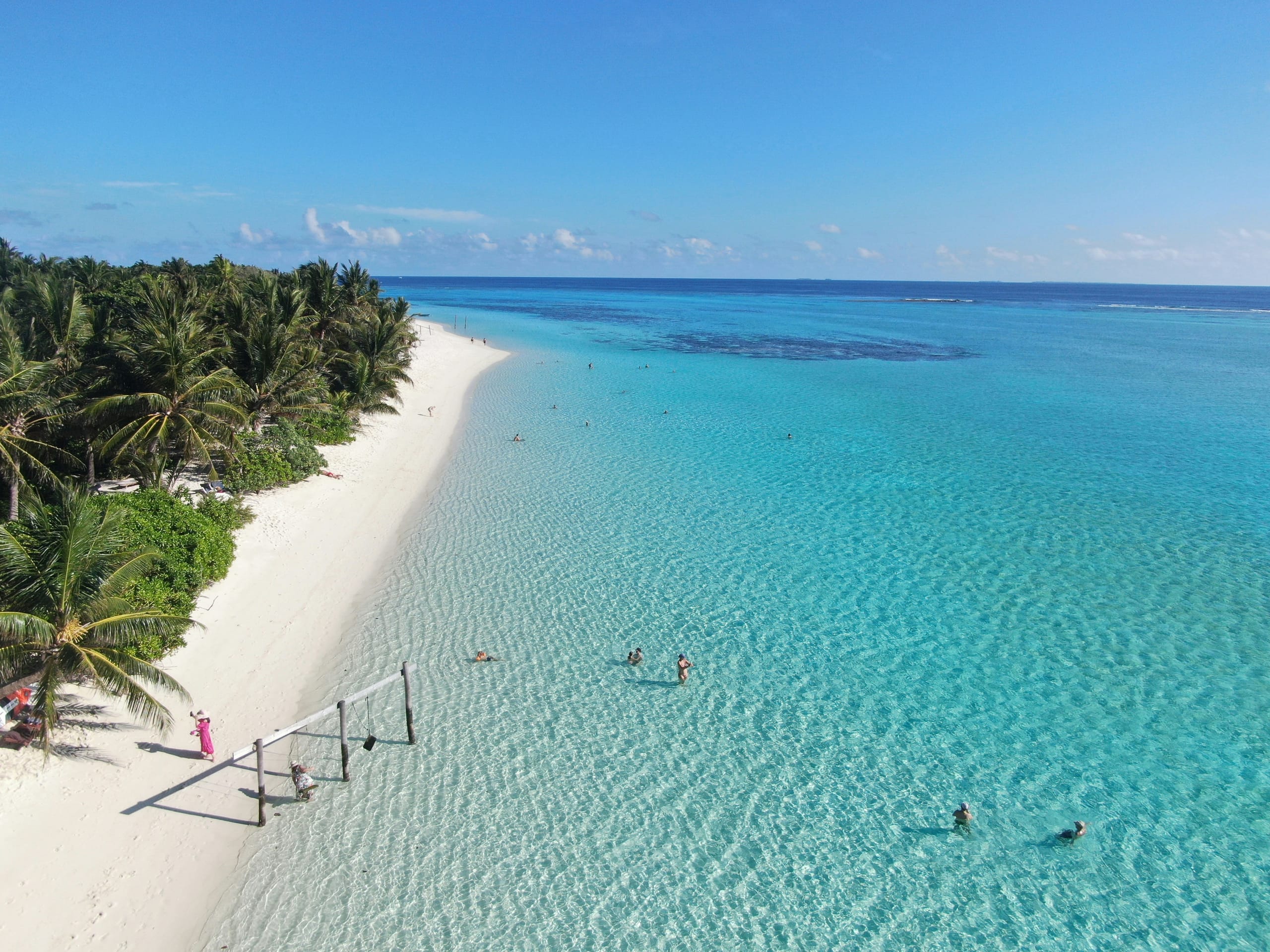
Every inhabited island that takes tourists sets aside a stretch of shore as a bikini beach, often screened off with a fence of palm fronds or a line of bushes. Inside it, swimwear is fine. Outside it, on the rest of the island's shoreline and on every street, shoulders and knees stay covered.
"You should be sensitive to local dress standards when outside holiday resorts, including on beaches used by locals."
In practice it is less of a production than it reads. You walk to the bikini beach in a shirt and shorts, you swim, you put the shirt back on before you leave. The catch is the size. On a small island the bikini beach can be one short strip shared with every other guest, a few sun loungers and a café with a blender. The reef in front of it may be lovely or may be rubble. A resort's beach goes all the way round.
If the beach is the point of the trip for you, ask every guesthouse on your shortlist where its bikini beach is, how far away, and what the water is like in front of it. Two guesthouses on the same island can sit ten minutes apart on foot and feel like different trips by the second morning.
Getting there is half the choice
Most comparisons leave this part until last, and it belongs near the front. The room you pick decides how you reach it, and the transfer shapes the first and last day of the trip more than any room will.
Resorts in the atolls nearest the airport send a speedboat. Further out, the transfer is a seaplane, a small floatplane that takes off from the lagoon beside the airport and lands next to your resort's jetty. The furthest resorts put you on a domestic flight to a regional airport and finish with a boat. Whichever it is, the resort arranges it and bills it per person, and it is the line on the invoice people forget to add up until it arrives.
Seaplanes come with one rule that catches a lot of people on their first evening.
"Seaplanes operate in daylight."
So a flight that lands in the late afternoon or the evening may not connect to a seaplane at all. You spend the first night near the airport and fly out in the morning, and whether the resort counts that night as part of your stay is a question for before you book, not for the transfer desk at dusk.
Guesthouse islands work the other way round. Nobody is waiting with your name on a sign. You take a shared speedboat from the jetty outside arrivals, or the public ferry from Malé, which is slow, costs very little and does not sail on Fridays. The ferry also does not leave from the airport, which is how a lot of first days end up longer than planned. The crossing from the airport to a guesthouse island works through that run against the flight times.
"Most ferries operate 3-6 times per week but never on Fridays (local holiday), with popular routes like Male-Maafushi running daily except Friday."
The night beside the runway
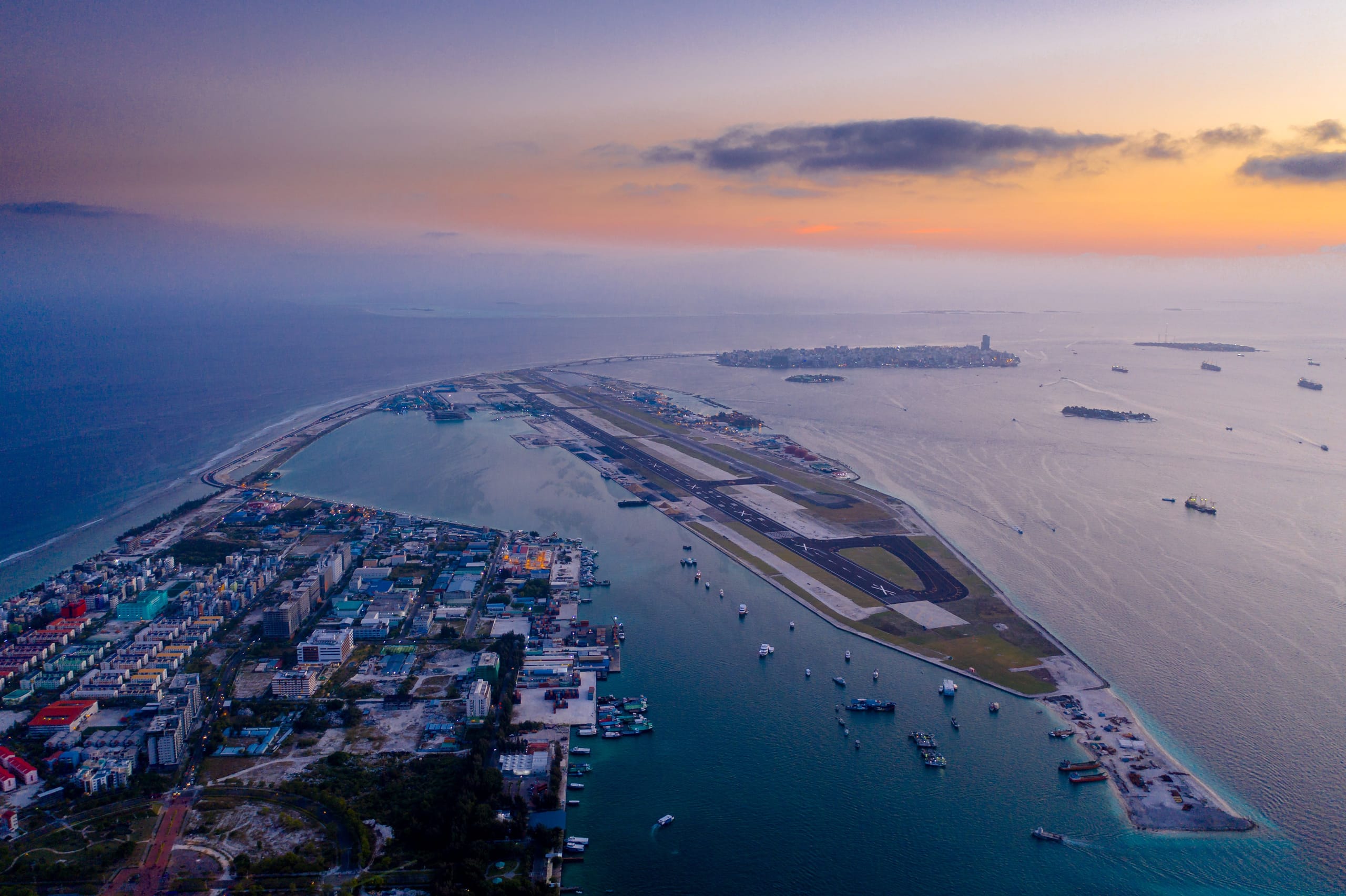
Either way, there is a fair chance the trip starts or ends with a night on Hulhumalé, the reclaimed island next to the airport. It is a grid of apartment blocks with a long city beach down one side, and it is better than its reputation. You can swim, eat grilled fish on the beachfront and be at the terminal in ten minutes. Book it on purpose rather than in a panic from the arrivals hall.
Who each one suits
A resort island
- A honeymoon, or any trip that is mostly about the two of you
- Wanting a drink with dinner, or at all
- Small children who need shade, a pool and a short walk to everything
- A reef off your own steps every morning
- A short trip, where the transfer has to be simple
A guesthouse island
- Wanting to meet the country, not only its water
- Divers and snorkelers who would rather spend on boats than on the room
- Traveling alone or with friends, and wanting other guests at breakfast
- Ten days or more, when a single resort island would start to feel small
- Not minding a dry island and a shared beach
Two of those rows need a second look. Families first. Guesthouse islands can be wonderful with children, who will be adopted by half the neighbors within a day, but the nearest pharmacy may be a boat ride away and the bikini beach may be a hot walk. Resorts built their kids' clubs and their shallow lagoons around exactly the family that worries about those two things.
Then divers, where the guesthouse often wins outright. Dive centers on the bigger local islands go out twice a day to the same channels the resort boats visit, and whatever you did not spend on the room goes into the water instead. What else the reception desk will sell you once you are there, and which of it earns its place, is laid out in a look at the excursions a guesthouse sells.
If you go local, pick the island first
On a guesthouse trip the island matters more than the building. The same room is a different week on a busy island and on a small one, and the reef, the beach and the boats all come with the island rather than with the guesthouse. These are the ones most people end up choosing between.
- Maafushi, Kaafu Atoll: the busiest, nearest and most built up. Dozens of guesthouses, dive shops competing along the main street, and a short speedboat ride from the airport. Easy, and it feels it.
- Gulhi and Guraidhoo in Kaafu, Fulidhoo in Vaavu: smaller islands on the same southern routes, a handful of guesthouses each and fewer boats in the harbor. On Fulidhoo, stingrays and nurse sharks come into the shallows off the beach.
- Ukulhas, Alif Alif Atoll: small and tidy, with a long record of sorting its own waste, and a beach and sandbank off the north tip.
- Thoddoo, Alif Alif Atoll: a farming island with watermelon and papaya through the middle, and a bikini beach on the west side that faces the sunset.
- Dhigurah, Alif Dhaal Atoll: a long, narrow sand spit with whale sharks working the outer reef all year, and a longer trip to reach it.
Two islands in a week is plenty. Every move between them is a boat and a morning, and the ferry timetable has its own views about which mornings those are. The full arithmetic of a guesthouse week, room, boats and food together, is in the budget for a local-island trip.
Once you have an island, A hotel booking site lists most of the guesthouses on it, and the map view is the useful part. It shows which ones sit on the bikini beach side and which are three streets back, behind the school.
Or do both
Our take
If the choice will not settle, do not settle it. Spend the first part of the trip on a guesthouse island and the last three or four nights on a resort. The local island first, while you still have the energy for ferries, prayer times and a beach with rules. The resort at the end, when you want to stop deciding things. Done the other way round, the guesthouse can feel like a step down. Done this way, the resort feels earned.
Two practical notes on the split. Pick a resort within speedboat range of the airport, so the last move does not hang on a seaplane's daylight. And do not plan the move off the local island for a Friday if it depends on the public ferry.
How many nights
Seven to ten nights is the shape that works. Under a week the transfers take too big a bite, because the arrival day and the departure day are mostly boats and waiting, and a seaplane resort can cost you a night at each end. A week splits well as four nights on a local island and three on a resort. Ten days leaves room for a second local island, which is usually where the trip starts to feel like a country rather than a hotel.
Before you book the room
- Check what time your flight lands, and whether that leaves daylight for a seaplane
- Ask the resort whether the transfer is included, and what happens if you land after the last one
- Ask the guesthouse where its bikini beach is, and what the reef is like in front of it
- Check your travel dates against Fridays and Ramadan
- Read the water activities clause on your insuranceSnorkeling from a boat is the clause that matters here.
Pros of staying on a guesthouse island instead of a resort
- You see the country and not only the hotel
- Your money goes to a family, a dive shop and a café rather than to one company
- The boats leave from the island's own harbor, a few minutes from your door
- Breakfast with other guests turns into plans for the day
Cons of staying on a guesthouse island instead of a resort
- No alcohol anywhere on the island
- Swimwear only on the bikini beach
- The beach is shared, and the reef in front of it varies
- Boats and ferries set the timetable, and Friday has no public ferry
When you go changes the answer
The dry season runs roughly from November to April, with flatter seas, clearer water and the busiest weeks of the year. From May the southwest monsoon brings wind and rain in bursts, through to about October.
The weather lands on the two kinds of trip differently. On a resort the island is the destination, so a windy afternoon becomes a book on a covered deck and the house reef is still there in the morning. On a guesthouse island most of the good days start on a boat, and in the wet months more boats get called off. If you are going local between May and October, leave a day or two of slack in the plan.
Check your dates against Ramadan as well, which moves every year. On a guesthouse island the cafés close through the day and the whole island turns around the evening meal. On a resort you would hardly know.
The things the listing leaves out
Connectivity is good on both. Resorts sell their wifi as a feature, and guesthouses mostly have it, sometimes strongest on the roof terrace. Phone data reaches the inhabited islands and most of the water between them, which matters when the boat schedule changes by text message. A travel eSIM covers the country and installs before you leave home.
Safety, on either kind of island, is mostly about the water. Crime against visitors is unusual on small islands where everybody knows everybody. Currents off the reef edge and through the channels are not unusual at all. Ask where to get in, swim with somebody, and take local advice about the channels seriously.
That is also why insurance matters more here than the room does. An inhabited island may have a health center and nothing more, and a resort's doctor is still a boat or a seaplane from a hospital. A rolling monthly travel policy is what a lot of independent travelers carry, and whatever you buy, read the evacuation line and the snorkeling and diving clause before you pay.
What a travel policy covers goes through which parts of a policy pay out and which do not.
The mistakes that cost a day
- Booking a seaplane resort for a flight that lands late in the day, and spending the first night in a city hotel nobody mentioned.
- Choosing a guesthouse by its room photos instead of by its island.
- Assuming every beach on a local island is a bikini beach.
- Planning the move between islands for a Friday.
- Packing a bottle for the guesthouse. Alcohol is on the list of things you cannot bring into the country at all.
- Trying to see four islands in a week and spending most of it on boats.
"It is illegal to bring in anything deemed contrary to Islam, including 'idols for worship', bibles, pork and pork products, and alcohol."
What surprises people
How small the islands are. You can walk round most inhabited ones in under an hour, and some resort islands in a quarter of that. A morning run on a resort is several laps and an apology to the same gardener each time.
How much of the trip is the boat, whichever island you pick.
How warm a guesthouse island is to someone who dresses for it. People who arrive braced for rules leave talking about the family that ran the place, and the uncle who wanted to know whether they liked the fish.
And how fast a resort stops feeling like a place. The first morning, with the light coming up off the lagoon and the reef under the ladder, is one of the loveliest things you will ever wake up to. By the sixth it is a very nice office with a lagoon attached.
The last evening
On the last evening on a guesthouse island you sit on the harbor wall with everybody else who has nowhere to be. Boys take turns jumping off the end of the jetty. A dhoni comes in with its engine popping and three men standing on the roof, and somebody beside you asks where you are from.
On the last evening on a resort you sit on your own deck and watch the color go out of the lagoon, in a quiet somebody has worked very hard to arrange for you. Nobody asks you anything.
Both of them are the Maldives. Only one has the country in it, only one has the silence, and nobody has found the island that has both.