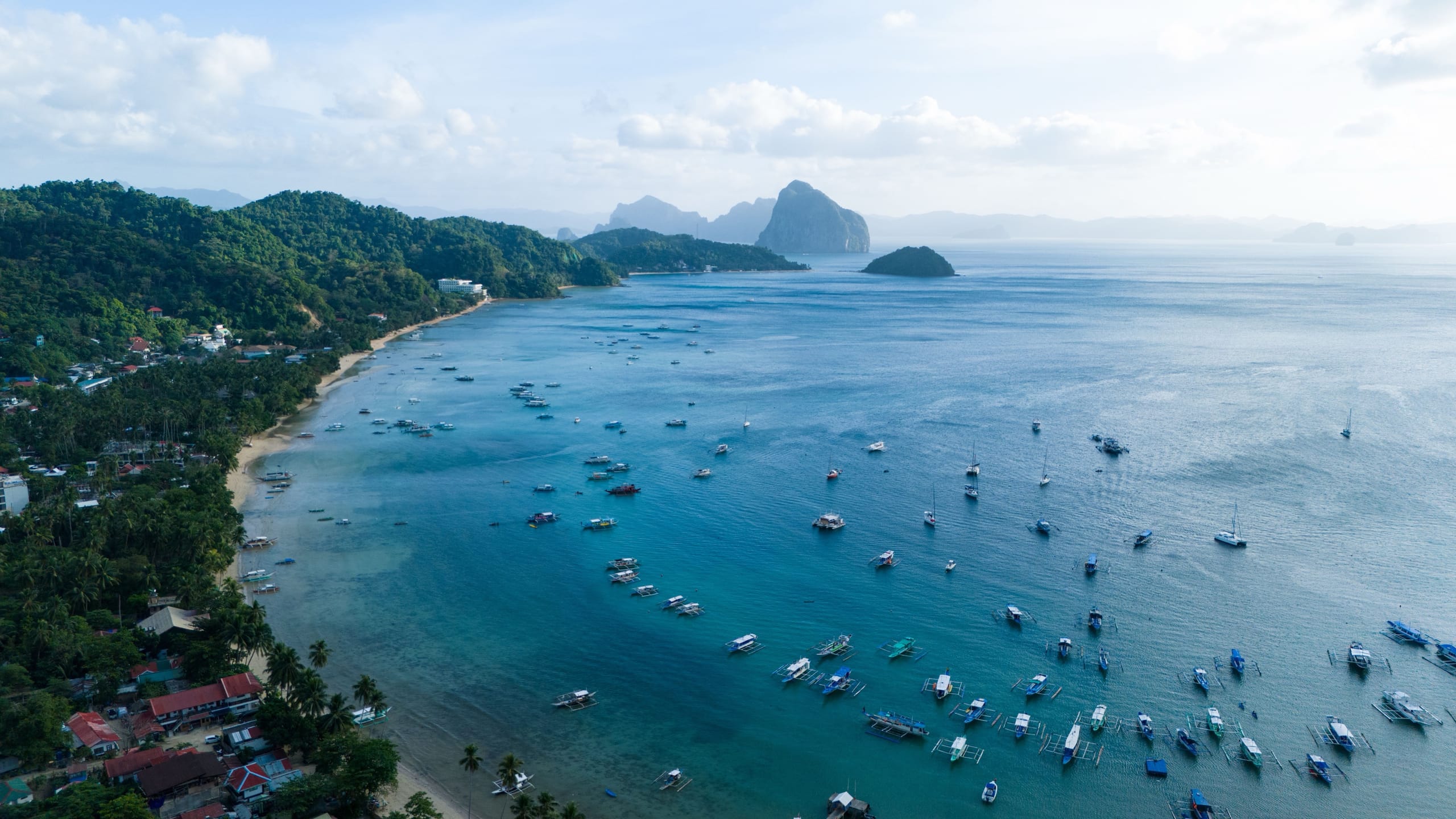
Match the route to the people on it. A family with small children wants D, which stays in sheltered water and never puts more than twenty minutes between stops. Anyone who came here to snorkel wants C, and should accept the longer runs as the price. B is the one that suits people who get restless on a beach, because it has the most variety and the least standing around. A suits everyone, which is the problem with it. The boats load at half past six. It is still gray at that hour, the light flat behind the limestone that stands over the town, and the bay has not decided what color it is yet. Crew move between hulls with plastic crates of ice and rice. Somebody bails a bilge with a cut-off bottle.
By eight the same stretch of sand carries forty boats and the water has turned the shade the photos promised. You are standing in it, shin deep, holding a life jacket nobody asked whether you wanted. Someone is calling a letter across the shallows. A. B. C. D. Yours is one of them, and you picked it the night before with very little to go on.
That is the part worth fixing before you get here. The four lettered tours are not four versions of the same day, and they have not been for years. The way most people choose between them, by reading a list of stops and picking the one with the best names in it, stopped working when the town started rationing the two places everyone came to see.
What the four letters actually cover
Each letter is a geographic loop around Bacuit Bay, drawn so the boat spends less of the day moving and more of it anchored. Five stops, roughly seven to eight hours, lunch cooked on board or laid out on a beach, snorkel gear and a life jacket in the price, pickup from town if you ask. What changes between them is how far out you go, how exposed the water gets, and how many other boats are doing the same thing at the same hour.
Tour A, and the lagoon everyone means
Tour A runs around Miniloc Island: Big Lagoon, Secret Lagoon, Shimizu Island, a lunch beach, and Seven Commandos to finish. It is the most booked route in town and has been since before the letters were formalized. If someone says they are doing island hopping in El Nido and names nothing else, this is what they booked.
Big Lagoon is the reason: a shallow channel between limestone walls, water so flat and green it looks corrected. Motorized boats stay outside; yours anchors at the mouth and you paddle in by kayak or board, discovering fast how a kayak handles.
You can also swim it. The water inside is not deep, the distance is short, and swimming gets you past the queue of boats at the entrance faster than paddling does, so the kayak is a preference rather than a toll. Small Lagoon is the one that needs the boat under you, because the way in is a gap in the rock.
The kayak has opinions about where you are going. It expresses them by turning.
Secret Lagoon is the other one people remember, and it is nothing like the first. You swim to a rock face, wait your turn, and slip sideways through a gap about the width of a doorway into a pool enclosed on every side. Ten minutes, maybe less, and out again. Shimizu has the best snorkeling on the route, coral close enough to the surface that you can see it while standing.
Tour B, caves and a sandbar
Tour B covers Snake Island, Cudugnon Cave, Cathedral Cave, Pinagbuyutan and Entalula. The stops sit farther apart, the boat spends longer between them, and the crowd thins noticeably. Snake Island is the one that gets photographed: a curved sandbar you can walk end to end at low tide with open water on both sides, and which vanishes completely when the tide comes up.
Cathedral Cave is a look from the boat rather than a stop, so if you were counting on going inside, adjust. Cudugnon you enter through a low gap and crouch under limestone that has been dripping for a very long time. Entalula has nothing built on it, which after two days of stalls and generators starts to feel like the feature it is.
I spent eleven minutes photographing the sandbar and then walked the length of it looking at my phone, checking whether the photographs of the sandbar were any good. The sandbar was right there the whole time.
Tour C, the long way out
Tour C goes farther into the bay than the others: Helicopter Island, Hidden Beach, Secret Beach, Matinloc Shrine, and a beach stop to finish. Longer runs, more open water, and the best snorkeling of the four if the visibility holds. Secret Beach is reached by swimming through a crack in a cliff wall, which is either the highlight of the trip or a hard no, and you will know which within about four seconds of seeing it.
It is also the route most exposed to weather. When the southwest monsoon is running, Tour C is the first one trimmed or rerouted, and the two swim-through beaches are the first stops dropped. If those are the reason you booked it, ask at the desk what the sea has been doing that week rather than what the itinerary says.
It is also the route that makes people sick. The crossings on C are the longest and the most open of the four, B is second, and a choppy hour in the middle of a seven-hour day is the difference between a good tour and one you spend on the rail. If you know you are prone to it, take something in town before the boat leaves rather than on the water, where it is already too late for it to work.
Tour D, close to town and slower
Tour D stays near shore: Small Lagoon, Cadlao Lagoon, Pasandigan, Paradise Beach and a lunch stop. Short crossings, sheltered water, smaller boats, less chop. It gets sold as the leftover option and it is not. Cadlao Lagoon is shallow enough to stand up in across most of its width and clear enough to watch your own shadow move over the bottom.
It is also where Small Lagoon sits on some operators' sheets and not on others, which matters more than any of the scenery, for a reason that has nothing to do with scenery. Check it before you pay. The letters are a local convention rather than a fixed timetable, and the sheets disagree.
Price guides published this year still print Small Lagoon inside Tour A, some print it on both, and at least one operator describes its own Tour A lagoon stop as either one. Ask the desk which lagoon is on their Tour A, by name. A reader who books A and D off a sheet where A already carries Small Lagoon sees one lagoon twice and misses the other, which is exactly the outcome this page exists to prevent.
The rule that changed the choice
In December 2018 the protected area office started enforcing a carrying capacity policy on Big Lagoon, Small Lagoon and Secret Beach. Fixed numbers of people inside at a time, fixed numbers of kayaks, fixed windows, motorized boats barred from the lagoons entirely, and operators required to book their slots in advance. The two lagoons were pulled out of the standard Tour A package and turned into permitted stops.
"The Small and Big Lagoons have also been removed from the regular Tour A package, as they are now premium tours and can no longer be visited on the same day."
Read that sentence twice. It is the whole decision. You cannot do both lagoons in one day, not on a joiner boat, not on a private charter, not by paying more. The cap is on the water, not on the ticket.
Quick fact
El Nido-Taytay Managed Resource Protected Area board resolution, reported by Rappler
| Big Lagoon | Small Lagoon | |
|---|---|---|
| People at a time | 60 | 30 |
| Kayaks at a time | 30 | 15 |
| Guest hours | roughly 7am to 4pm | roughly 7am to 4pm |
"Big Lagoon: 720 guests per day, 60 guests allowed at a time. 30 kayaks or paddle boats allowed at a time. 45 minutes max stay in lagoon."
The same policy killed the combination tours. For years you could buy an A and C or a C and D and cram two loops into one long day. Municipal rules no longer permit that, so the maximum useful unit is one tour per day and there is no upgrade path around it.
Operator sites still list Combo A and B, Combo A and C, Combo C and D as products, which is confusing until you see what is actually being sold: a private charter running stops from two routes, without entering the capped lagoons. The stops are genuine. Permitted sites are not in it. If a combo is quoted to you with Big Lagoon on the list, that is the sentence to question.
"Combination tours that crammed two routes into one day are no longer permitted."
What the brochures leave out
The four letters are still printed everywhere as if they were four flavors of the same product. They stopped being that in 2018. What they are now is a booking system wrapped around two rationed lagoons, and everything else on the sheet is the day built around whichever slot you got.
Picking the lagoon before you pick the letter
So the order of the decision runs backward from how it is usually explained. You do not choose a tour and receive a lagoon. You choose a lagoon, and the tour arrives attached to it.
Big Lagoon is the one worth the permit if you are only getting one. It is bigger, the walls are higher, and the paddle in from the anchorage takes long enough that the boat noise falls away behind you. Small Lagoon is tighter and more sheltered, entered through a gap you duck under, and on a busy morning it can feel like a waiting room with cliffs. Both are worth doing. Neither is worth doing badly.
The permit slots are limited and the good ones go first, which means the desk needs a day's notice, sometimes more in the high season. Booking the morning of, at the last open counter on the strip, is how people end up with the route they did not want on the day they had left.
If you have two days on the water, the pairing that gets you both lagoons is Tour A and Tour D. That is not the pairing most itineraries suggest, and it is the one most people are disappointed to have missed. If you have three, add B or C depending on what the sea is doing, and go into the El Nido guide for the stop-by-stop detail on each route.
What the day is actually shaped like
6:45amPickup
A tricycle or a van collects you from town. The beach is loud, wet and disorganized, and it stays that way for twenty minutes.
8:00amFirst stop
Usually the farthest one, taken early while the water is flattest and the light is still low.
10:30amThe permitted stop
Your lagoon slot, if you have one. Kayaks come off the roof. You get 45 minutes and the clock is enforced.
12:30pmLunch on a beach
Grilled fish, chicken, rice, eggplant salad, fruit. Eaten standing up, mostly, with sand in it.
2:30pmSnorkel stop
The stop people skip in favor of lying on the deck. It is often the best one.
4:30pmBack on the sand
Sunburned in a stripe where you missed. Salt in everything you own.
That first line is the optimistic version. Twenty minutes is what the beach looks like on a good morning. On a joiner boat it can be an hour, and firsthand accounts put it at up to two, because the boat leaves when the last person on the manifest turns up and nobody on the beach is in charge of that person. Private boats push off around half past eight while the joiners go at nine. If you are weighing the charter and the flexibility argument has not moved you, this is the part that actually buys something: the morning back.
The engine on a bangka has one volume and it is committed to it. Conversation happens at the stops. Between them you sit, you watch the limestone slide past, and after the second hour you stop trying to talk and just let the noise happen.
The order to do them in
Front-load the exposed routes. C and B go farther out and are the first to be cancelled or trimmed when the wind gets up, so putting them on your first available day gives you a second chance later in the week. A and D stay closer in and survive weather that shuts the outer bay down.
The other reason to sequence this way is crowding. Tour A leaves under the heaviest load of any route, and the boats that leave last arrive at Big Lagoon in the middle of the day when every slot is full. If you are booked on A, be at the desk early and ask for the first dispatch rather than the convenient one.
- A joiner ticket normally covers the boat, a guide, lunch, drinking water, a mask and snorkel, and a life jacket. Confirm the lunch when you book, because the operator this page cites promises a buffet on one page and tells guests to bring their own food on another, and both notices are live
- It does not cover the eco-tourism development fee, which is collected separately and once
- It does not cover lagoon entrance fees or kayak rental, both paid on the water
- The Matinloc Shrine landing on Tour C is a separate optional fee at the site
- Tips for the crew are not included and are handed over directly when the boat gets back
Almost every complaint about El Nido tour pricing traces back to that list. The advertised number is the boat. The day is the boat plus four small payments, and the four small payments are the ones nobody mentions when you are choosing. It is the same shape as most of the costs that go missing from a trip budget, which is to say the total is knowable in advance and almost never published.
Sharing a boat or paying for your own
A joiner tour puts you on a boat with fifteen to twenty-five strangers for around $20 to $25. A private charter puts your group alone on a boat and buys you the one thing money can still buy here: the order of the stops. Published rates run roughly 6,000 to 12,000 pesos for the boat for the day, call it $97 to $194, plus the same per-person fees everyone pays.
Divide by four. That is $25 to $49 each against a joiner seat at $20 to $25, so the flexibility is close to free at the bottom of that range and about double at the top. Run that arithmetic at the desk rather than carrying an assumption into it.
Pros of chartering a private boat instead of joining a group tour
- You choose the order, so you can hit the permitted lagoon at opening rather than at noon
- You can skip a stop nobody in your group wants and spend the time somewhere else
- Departure is when you are ready, which on a route like C saves an hour of open water in the chop
- Smaller boat, shallower draft, so a few anchorages are easier to get into
Cons of chartering a private boat instead of joining a group tour
- Several times the price of a joiner ticket, and the gap is widest for one or two people
- You still cannot do both lagoons in a day or combine two routes, because the caps apply to everyone
- The lagoon slot still has to be booked ahead, so paying more on the day fixes nothing
- You lose the boat full of people, which on a long day is more of a loss than it sounds
For two people, joiner tours are the sensible call and the crowding is survivable. For four or more, split a charter and the per-head cost lands somewhere between the joiner price and about double it, depending on the boat you get quoted. That is the only version of this where paying more can buy a better day, and it is worth doing the division at the desk rather than assuming either answer.
I booked a joiner boat for the first day and told myself it was for the atmosphere. It was for the twelve dollars. Then I paid four dollars for a kayak, paddled it maybe two hundred feet, handed it back to the guide and swam the rest, having rented, at some expense, the right to be photographed in a kayak.
What the water actually costs you
The eco-tourism development fee is the one people trip over. It is paid once, it covers you for ten days, and every tour operator in town collects it before you board. It went up to 400 pesos in June 2024 after more than a decade at half that, so older guides and older forum threads have the wrong number in them.
"400 PHP for non-Palawan resident tourists, valid for ten days."
At 62 pesos to the dollar in August 2026, that is about $6.45. The lagoon entrance fees run 200 pesos each, near enough $3.25, and kayak rental inside the lagoons runs somewhere around $2.50 to $5. Published figures range from 150 to 300 pesos and no office publishes a set rate, so ask the crew what theirs is rather than assuming it is fixed.
Two days on the water, per person
Tour C runs a few dollars more than the others because of the distance, and the Matinloc Shrine landing adds about $3.25 on top if you want to walk up to the viewpoint. Nothing here is expensive. It is simply that none of it happens on a card. Bring the day's cash with you in small notes, because the boat does not have change and neither does the guy renting kayaks in a lagoon with no electricity. Cash in El Nido has the number to draw before the van leaves, and which machine in town to draw it from.
Withdrawing what you need before you get on the water is worth planning around, and the fee structure on foreign cards is its own small tax. There is a fuller version of that arithmetic in the piece on how to handle money abroad without bleeding fees, and it applies exactly here.
The morning the boats do not go out
This is the part no tour page plans for and everybody eventually meets. Island hopping is an open sea activity in a country with a monsoon and a typhoon season, and the call to sail or not is not made by your operator. The coast guard makes it, usually first thing in the morning, and when it goes against you, every boat on the beach stays on the beach.
Alert
Cancellations are decided the morning of
Operators generally hear around 7am whether boats are dispatching. Keep the phone number you booked through, keep your messaging app reachable, and do not book an onward flight or a van for the afternoon of your last possible tour day.
It is not a rare event. During bad weather the coast guard has suspended island tours across northern Palawan outright, and in monsoon months the more common version is a partial call: the outer routes are pulled, the sheltered ones still run, and everybody who booked C gets moved to D.
Who took the money decides what happens to it. Tour operators set their own refund terms, so read them before you pay a deposit and prefer the ones that reschedule rather than credit. Government fees behave differently. The environmental user fee is stated as non-refundable except in force majeure situations, which is exactly what a weather stand-down is. When the coast guard cancels the boat is the longer account of who makes that call and what happens to the money afterward.
Weather cancellations are the one variable in El Nido you cannot buy your way around.
The practical defense is slack. Three nights in town to fit two tours in, four if the forecast looks bad, and a plan for the grounded day that does not require a boat. Nacpan Beach, the climb up Taraw, the waterfalls inland. A cancelled morning is only a disaster if it was your only morning.
It is also the case a policy exists for. Trip disruption and missed connections are the parts of a travel policy that earn their money in places like this, and the breakdown of what travel insurance covers lays out which cover actually pays and which is decoration.
Small things that change the day
Reef-safe sunscreen, applied before you leave, because you will not reapply it properly on a moving boat. A dry bag, not a plastic bag. Water shoes for the coral and the rocks at the swim-through beaches, which are sharper than they look from the deck. A shirt you can swim in, because five hours of open sun on your back is a different injury from a sunburn.
None of that has to come in your luggage: the shops on the main street rent snorkel gear at 100 to 200 pesos a day, fins at around 150, water shoes at about 100 and a dry bag for a few hundred. The fins are worth noticing on Tour C, because the ticket covers a mask and snorkel and stops there, and the snorkel stops on that route are the ones where fins earn their money.
Leave the drone. Big and Small Lagoon sit inside a protected area with a rule sheet that covers noise, and the guides enforce it. Loud music is out for the same reason, and so is cliff jumping, which somebody on your boat will suggest anyway. And leave the bottled water, because single-use plastic is banned on the boat tours outright, plastic bottles included. Bring a refillable bottle instead. The boat carries drinking water and pours it for you, so the only thing a six-pack from the shop buys you is an argument at the beach.
"Plastic bottles are also banned on all boat tours. Tourists are always encouraged to bring a tumbler when going on tours."
On the boat itself the risk is mundane and worth naming. The decks are wet and the ladders are steep, most cuts happen on coral in shin-deep water at a landing, and the sun on open water burns people who have never burned before.
Wear the life jacket at the swim-throughs even if you swim well, because the swell moves you into rock rather than away from it. If something does go wrong, the nearest hospital of any size is five hours away by road. Getting sick a long way from a hospital is what that distance means: what the town can treat, what has to leave, and who decides.
Signal disappears past the headland and does not come back until the boat turns for town, which is either a problem or the best part of the day. Download the map before you go. If you want the booking confirmations reachable from the water, a local data plan is the fix, and the comparison of eSIMs against a physical local SIM covers which one to get before you fly.
The other thing worth knowing is when to be here at all. The bay flattens out in the dry months and the water clarity that all these photographs depend on is a seasonal condition, not a permanent one. Getting the timing right matters more than getting the letter right, and it is a decision you make months earlier, before any of this is bookable.
The southwest monsoon runs through the middle of the year and it does not rain constantly, but it does put wind on the water, and wind is what cancels boats. The dry stretch either side of the new year is when the bay is glassiest and also when every permit slot and every room in town is spoken for. There is no month that gives you both.
Getting into town is its own logistics problem, and it changed this year, so read the current routing into El Nido before you book anything else. The tour desk cannot help you with a flight that no longer exists.
Book the boat through your accommodation if you can. Not because the price is fixed, which is the reason usually given and is not true: the same Tour A runs from about 1,200 to 2,200 pesos depending on where you buy it, and the online platforms sit at the top of that. Book through your accommodation because a place you are already staying at has a reason to care whether your lagoon slot exists, and will chase it on the morning when the answer is unclear. Ask what the walk-in rate is anyway before you agree to a number.
Rooms in town book out first in the dry season, and the ones with a tour desk go earliest.
Look at places to stay in El NidoThe last hour
The best part of a tour day is not any of the stops. It is the run home, four in the afternoon, when the light goes long and gold across the water and everyone on the boat has stopped talking. Salt drying on your arms. Somebody's phone playing something quietly at the front. The limestone stacks going dark against a sky that is still bright behind them.
You will not remember which letter it was. You will remember the hour on the way back.
Which is where planning stops being useful. Get the lagoon slot booked, front-load the exposed routes, carry the day's cash, leave a spare morning for the weather. Do that and the rest of it is out of your hands, which in a bay that has been rationing itself since 2018 is close to the point.
The letters were only ever a way of dividing up something that does not divide. Four days out there and you would still be finding beaches nobody put on a sheet.