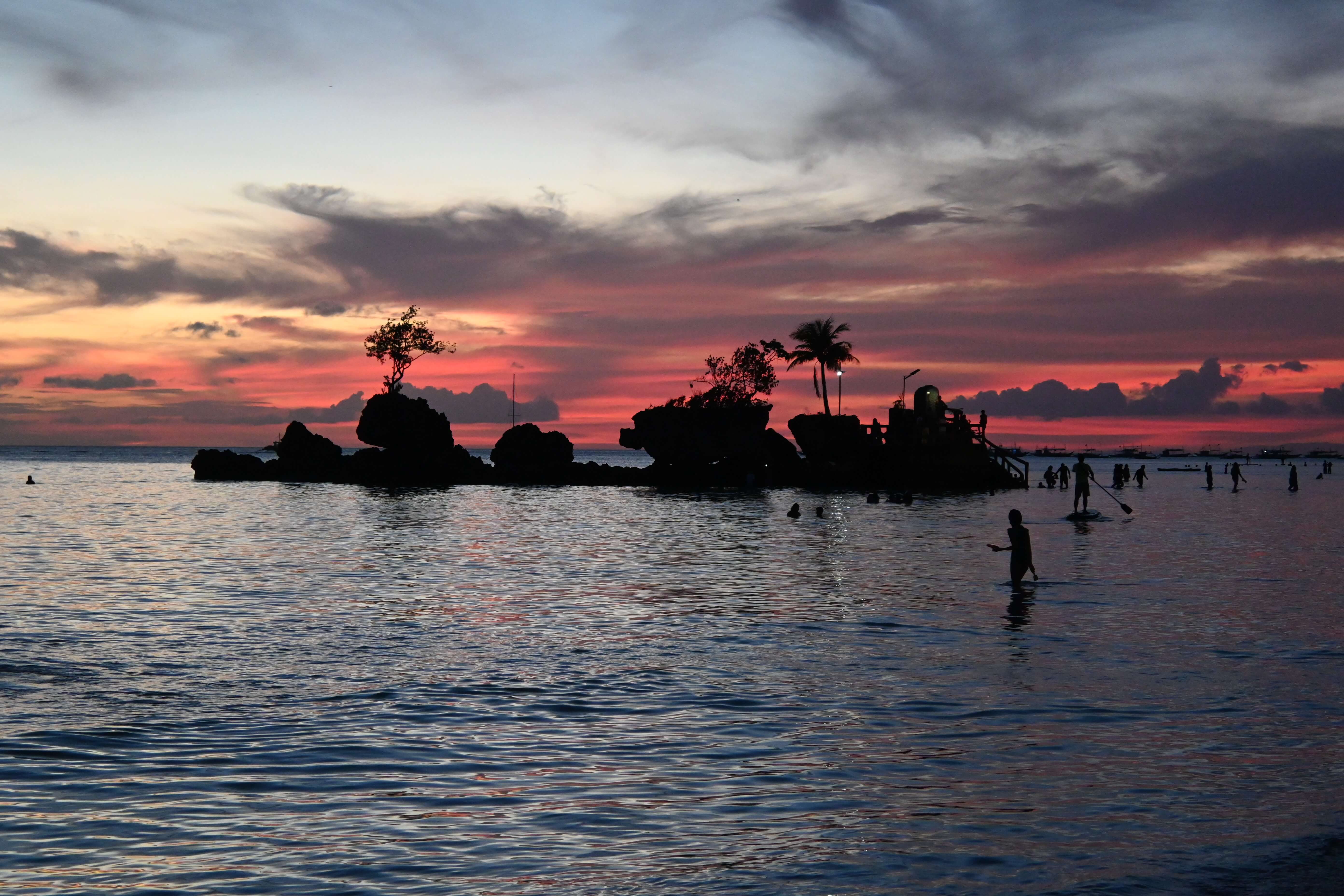
Fly into Clark International, north of Manila, then take the ninety-five-minute hop to Lio Airport, about 2.5 miles from town. That is the quickest route on paper. If your long-haul ticket lands at Manila's Ninoy Aquino instead, add two to three hours of ground transfer to Clark before any of it starts, and the jet to Puerto Princesa plus a shared van often puts you on the same beach at the same hour for a third of the money. The van door slides back and the heat gets in before you do. Behind you, most of a day of Palawan highway and a driver who took the last hour of corners like a man who has stopped thinking about them. In front, a street of low buildings, a strip of gray sand, and limestone standing up out of the water at the end of it.
Nobody ends up in El Nido by accident. It sits near the top of a long island, at the end of a road that gives up shortly afterward, and every person on that beach solved a routing problem to get there. Most of them solved it with advice that expired in March.
The short answer hides a decision that costs most people half a day, and it is not the decision they think they are making. It is not flight versus van. It is which airport your inbound ticket lands at, and how many hours of Philippine road you are willing to spend before you get to the part with the boats in it.
Two routes carry almost everyone, and a third carries people arriving by sea. What matters is not speed, but how much can go wrong.
Updated
29 March 2026 · Cebgo and AirSWIFT moved every remaining turboprop flight out of Manila's Ninoy Aquino airport to Clark International. There is no longer a NAIA departure to El Nido at all. From 1 July 2026 those same flights carry Cebgo DG codes instead of AirSWIFT T6 ones.
- The Manila (NAIA) flight to El Nido is gone. Every remaining Cebgo and AirSWIFT flight now departs from Clark International instead, since 29 March 2026.
- Route one, through Clark: about 1 hour 35 minutes in the air, $57 to $165 one way, plus 2 to 3 hours getting from Ninoy Aquino to Clark if that is where your international flight lands.
- Route two, through Puerto Princesa: a roughly ninety-minute jet flight for often under $50 booked ahead, then a 5 to 6 hour shared van at $11 to $13 a seat.
- From 1 July 2026 the same El Nido flights switch from AirSWIFT's T6 booking code to Cebgo's DG code. Same aircraft, same route, just a different code on the ticket.
The flight that no longer leaves Manila
For years the answer to this question fit in one line. Fly to Manila, cross to the domestic terminal, take a small propeller plane to a strip called Lio, be in the water by lunch. That line is dead. The Department of Transportation spent 2025 and early 2026 pushing turboprop operations out of Ninoy Aquino to free up slots, and on 29 March the last of them went, El Nido included.
"Starting March 29, 2026, all Cebgo (DG) and AirSWIFT (T6) flights will transfer from Ninoy Aquino International Airport (MNL) to Clark International Airport (CRK)."
Clark sits about 50 miles (80 km) north of Metro Manila. On a map that looks like a suburb. On a weekday afternoon it is two to three hours of expressway and toll booths, and every one of those hours has to be taken out of a day that already had a long-haul flight in it. That is the whole story of this change. The flight did not get slower. The morning in front of it got longer.
None of which touches what is waiting at the other end. El Nido itself has not moved, the water is the same temperature it was in February, and the town is still small enough to walk across in twenty minutes with a bag on your back.
One more piece of housekeeping, because it confuses people at check-in. From 1 July 2026 the El Nido flights are operated under Cebgo's DG codes rather than AirSWIFT's T6 ones. Same aircraft, same route, same crew. Two different letters on the booking. If you bought a T6 ticket earlier in the year and your confirmation now says DG, nothing has gone wrong.
"Existing AirSWIFT T6-coded flight numbers will be replaced by Cebgo's DG-coded flight numbers from July 1, 2026."
Route one, through Clark
This is the fast route, and once you are standing in the right terminal it is fast. Published schedules in mid-June 2026 showed 31 weekly departures between Clark and El Nido under the AirSWIFT code with another nine under Cebgo, which works out to several most days rather than the three-a-week service some older pages still describe. The flight is about an hour and thirty-five minutes in an aircraft that seats fewer people than a city bus and lands on a runway you can see the end of from the door.
Clark itself lands better than expected if your assumptions were set by Ninoy Aquino. The terminal is wide and cool and mostly empty outside the morning bank of departures, and the walk from the bus drop to the check-in desks takes about four minutes. Everything painful about this route happens before that walk.
Mode
P2P bus or private car
Duration
2 to 3 hours
Cost
About $7 by bus, $25 to $41 by car
Bus tickets are sold at the counter on the day. No reservations, first come first served, and the queue is longest right after a wave of international arrivals.
Mode
Turboprop flight
Duration
About 1 hour 35 minutes
Cost
$57 to $165 one way
Baggage is not in the base fare. Add it when you book. Adding it at the counter costs more and the aircraft fills its hold early.
The buses go from inside NAIA Terminals 1, 2 and 3 and from Ortigas, hourly, first at two in the morning and last at seven in the evening. The fare is 380 to 450 pesos depending on the terminal and whether the coach is air conditioned, which is six to seven dollars at the August 2026 rate.
Read both ends of that clock. Nothing leaves between seven at night and two in the morning, so a late landing either waits or pays for a car. And the flight you are aiming for goes in daylight anyway, so work backwards from the departure time and then add ninety minutes on top. Manila traffic does not have a worst case, it has a range that keeps widening while you watch it.
"From NAIA Terminal 1, NAIA Terminal 2, NAIA Terminal 3, and Ortigas, the first trip departs at 2:00 AM and the last trip at 7:00 PM, with one hour intervals per trip."
I once booked the first departure out of Clark on the theory that I would sleep on the bus. I did not sleep on the bus. I arrived at Lio having been upright for twenty-two hours and spent my first afternoon in El Nido unconscious in a room with the curtains shut, which is an expensive way to look at a limestone bay.
If your international ticket already lands at Clark, and a growing number of them do, none of the above applies and this route is not a close call. You walk across, you wait, you fly, you are eating dinner on the beach. The whole argument only exists because most long-haul tickets into the Philippines still land at Ninoy Aquino.
Pros of flying into El Nido through Clark
- Roughly an hour and thirty-five minutes instead of most of a day on a road
- Lands 2.5 miles from town, so the transfer at the far end is a fifteen-minute tricycle ride
- Several departures most days, which gives you room to move if plans shift
- No overnight stop needed if your inbound flight arrives in the morning
Cons of flying into El Nido through Clark
- Costs three to five times what the Puerto Princesa route costs, before baggage
- Two to three hours of ground transfer first if you land at Ninoy Aquino
- Small aircraft, strict weight limits, and baggage that has to be bought in advance
- Miss the last departure of the day and there is no later one to catch
Route two, through Puerto Princesa
Puerto Princesa is Palawan's capital and its jet airport, and it still takes flights out of Ninoy Aquino. Something like nine departures a day from Manila alone, on aircraft with jet engines and overhead bins that shut properly, at fares that regularly sit under fifty dollars if you book with any notice at all. The flight is roughly ninety minutes. Then you get in a van.
The van does not leave from the arrivals hall, or at least the affordable one does not. Drivers meet flights at the door and walk you out to the lot, or you take a tricycle fifteen minutes across town to the San Jose terminal, a covered yard full of white minivans with cardboard signs propped in the windscreens. Somebody will ask where you are going before you have finished looking around. Say El Nido and you get pointed at a van, and the van leaves when it fills or when the schedule says, whichever happens first.
Mode
Shared minivan
Duration
5 to 6 hours
Cost
$11 to $13 per seat
Runs from the San Jose terminal and from the airport. Published departures run from around 3am to mid-afternoon, heaviest early and thinning after lunch. A private van for up to ten people is about $147.
Five to six hours is the band, and the published figures cluster at the lower end of it, four and a half to five and a half. The highway is paved almost the whole way now, which people report as though paved meant flat. It does not. Your first three hours are farmland and small towns and a lunch stop where everyone buys the same crackers. The last ninety minutes climb and turn.
The road has opinions about that final stretch. So does the van, which was built for a smaller category of human and has two air conditioning settings, off and arctic, with the dial mounted somewhere near the driver's knee. You will not be consulted about the dial. If you get carsick at all, take something for it in the terminal rather than in the van. The same goes for the ferry from Coron. Both of those work if they are already in you when the motion starts and mostly do not if they are not.
Five to six hours is not a transfer. It is most of a day, and it is the part of the trip nobody photographs.
Book the seat the day before in high season. Turning up at two in the afternoon hoping for a spare seat is how people end up spending a night in Puerto Princesa they had not planned on, and Puerto Princesa is a working city, not a beach town. It is a fine place to eat. It is a poor place to lose a day.
The lunch stop is its own small institution. Every van pulls into the same handful of roadside places around the halfway mark, and the offer is a row of steel trays under glass. Chicken adobo going dark in its own sauce, fried fish, a vat of rice, green mango sliced and salted. You point, somebody scoops, it costs about two dollars. The coffee is instant and arrives pre-sweetened whether you asked for that or not. Twenty minutes later everyone is back in their seats smelling faintly of garlic.
The bus, if you have the day
There is a bus, and it does not leave from where the vans do. Cherry Bus goes from the Irawan terminal out past the crocodile farm, roughly ten kilometers west of the center, so add a tricycle and half an hour before the seven to nine hours on the road even start. It stops more often than the van and it comes in two fares: about 610 pesos without air conditioning and about 860 with, which puts the cool one above the low end of the van band rather than under it.
Air-conditioned coaches run the route daily and the seats are wider than the van's, which after hour five stops being a small thing. Right choice on a tight budget and a loose schedule. Wrong choice if you have a boat booked the next morning and any doubt in your mind about arriving in time to sleep.
"Both the bus and van are NOT allowed to enter El Nido town due to its small roads."
Route three, by sea
The ferry from Coron is the third way in, and it is the one people take when El Nido is the second half of a Palawan trip rather than the start of one. If you are still working out which of the two you want first, that is a separate argument with a separate answer.
Mode
Fast ferry
Duration
3.5 to 4 hours
Cost
About $29
Three operators sail it daily, two in the morning and one around midday. Check in an hour ahead. Passengers only, no vehicles, and the sailing is weather dependent.
"Montenegro Lines runs a daily fast ferry between El Nido and Coron at a regular fare of 1,760 pesos, with check-in one hour before departure."
Worth correcting a line that appears on most pages about this crossing. It is not one boat a day. Jomalia, Philmal and Montenegro all run it, and on the published board they leave Coron at around half past seven, twenty past eight, and half past twelve, at fares between 1,760 and 1,800 pesos.
That still means the day has a shape: two boats before nine and one after lunch, and if the sea has been called off there is no evening option to fall back on. The board also carries its own warning that the times move without notice, so confirm at the pier the day before rather than trusting a screenshot.
Open water, four hours, and a sea that behaves in March and argues in August. The Coast Guard suspends the crossing when the weather says so, and the operator does not get a vote. That is why nobody sensible books a same-day onward flight out of Manila for the evening they are due to land in El Nido by boat. What happens when the Coast Guard cancels the boat is the version of that morning nobody plans for.
The arithmetic nobody publishes
Put the routes side by side from the same starting point, an international arrival at Ninoy Aquino at ten in the morning, and the ranking stops being obvious. These are door-to-door numbers, terminal exit to El Nido town, with the waiting included, because the waiting is most of it.
| Route | Door to door | Rough cost | What can break it |
|---|---|---|---|
| Bus to Clark, then fly to Lio | 8 to 10 hours | $70 to $180 | Traffic on the expressway, then no later flight to catch |
| Car to Clark, then fly to Lio | 7 to 9 hours | $90 to $210 | Same, minus the queue at the bus counter |
| Fly to Puerto Princesa, then shared van | 9 to 11 hours | $45 to $70 | A delayed jet, then no van left for the afternoon |
| Fly to Puerto Princesa, then overnight, van at dawn | Next day by noon | $70 to $100 | Almost nothing, which is the point of it |
The Clark route wins on paper by roughly two hours. It loses on money by a wide margin, and it loses outright if your inbound flight is late, because there are only so many El Nido departures in a day and missing one costs you the whole day rather than an hour of it. The Puerto Princesa route is slower and more forgiving. Vans keep leaving. Planes do not.
Both routes have a more expensive version that fixes the fragile part. A private car to Clark removes the bus queue and about forty minutes of it. A private van out of Puerto Princesa removes the waiting and the stranger's elbow for about $147 for up to ten people, which stops looking extravagant at four passengers and starts looking obvious at eight.
Through Clark
- Fastest on the clock, by about two hours
- Three to five times the fare
- One missed connection ends the day
- Best when your inbound lands before noon
Through Puerto Princesa
- Slower, and much harder to break
- Under seventy dollars all in
- Vans keep running through the day
- Best when your inbound lands late or you value the slack
That transfer is the line item people leave off the budget and then pay anyway, which puts it in the same family as the costs that never make it onto the spreadsheet. Two hundred dollars of getting there does not feel like part of the trip until it has come out of the same account as everything else.
What your arrival time actually decides
Lio is a daylight airport. Vans out of Puerto Princesa start before dawn, run heaviest in the morning, and the published board stops in the middle of the afternoon. The Cherry Bus board is shorter still, first at seven and last at eleven in the morning. Both facts point the same direction: a long-haul arrival that clears Manila immigration after lunch is not reaching El Nido that day, whichever route you paid for. You can spend the money finding out, or you can look at your arrival time before you book and plan the night.
Landing after dark
If the numbers do not work, stop fighting them. Land after seven in the evening and the bus to Clark has already stopped for the night, which settles the argument for you. Take the night near whichever airport you land at, sleep, and go at first light. One hotel night. It saves you arriving somewhere worth looking at while too tired to look at it.
Rooms near both airports are plain and functional and that is the entire point of them. Look for a shuttle and a front desk that will let you check out at five in the morning without a conversation. Do not spend long choosing. You will see the ceiling, then the alarm.
- Register on eTravel inside the 72-hour window before your flight. The system rejects anything earlier.
- Add baggage to the turboprop ticket at the time of booking, not at the airport.
- Book the van seat or ferry ticket a day ahead between December and April.
- Draw pesos in Manila or Puerto Princesa. The machines in El Nido town run dry on weekends.
- Leave the first morning in El Nido empty. Boats leave at seven and you will not want to be on one.
What the timetable does not tell you
Three things catch people out on this trip, and none of them appear on a schedule.
The first is that the timetable and the departure are separate events. A van listed for eleven leaves when it fills. A ferry with a printed hour boards well before it and pulls away when the Coast Guard signs off. Nobody is being careless about this. The system runs on conditions rather than on paper, and arriving with paper in your hand is how you spend a morning annoyed about something that was never going to work the way you assumed.
The second is the weather window. The dry months run November through May, and that is when the boats sail, the sea flattens out and the town fills up. From June the wind swings around, the afternoon rain arrives on a schedule of its own, crossings get called off more often, and the road north slows where the water sits on it. Fares drop in those months for a reason, and the reason is not a secret. The wet season in the Philippines goes through what that half of the year actually costs you.
Which raises the question the schedule does not answer: what a cancelled flight actually costs you. On the money, not much. A cancellation gets you a seat on the next available flight, a free rebooking inside thirty days either side, a travel fund, or your fare back to the card within fifteen days, and you pick which.
There is no cash on top of that for weather, and nobody is owed a hotel by law. What it costs you is the day, and that depends on which end you are standing at. Cancelled at Clark, there is still a jet to Puerto Princesa most afternoons and a road at the other end of it. Cancelled at Lio, there is one road out and it is five hours long.
"Rebooking your flight for free up to 30 days before or 30 days after the original schedule."
The third is trip length. People give El Nido two nights because two nights is what fits around the flights, then spend one of them recovering from the day they spent arriving. Four nights is where the trip stops being a transfer with a beach attached to it. Five, if you want to leave a day spare for the weather to be wrong.
The paperwork and the fees
Every arrival registers on the government eTravel portal ↗ within 72 hours of the flight. It is free, it takes about ten minutes, and the system will not accept a submission earlier than 72 hours out, which reliably catches the sort of person who packs a week ahead. Save the QR code to your phone before you leave for the airport.
The onward ticket is being asked for because of what the stamp says. Most nationalities the site writes for get thirty days visa free on arrival, and immigration wants to see that you intend to leave inside them. Plan longer and you are not turned away. You extend at a Bureau of Immigration office, first to fifty nine days and then in increments after that. But not from the plane. A three week itinerary that quietly becomes five is the way people find out.
"Non-visa required tourists admitted initially for thirty (30) days."
Then there is the town's own charge. El Nido collects an Eco-Tourism Development Fee, currently 400 pesos, around $6.45 at the August 2026 rate of 62 pesos to the dollar. It is valid for ten days and it is collected before your first boat tour rather than at the airport, usually by someone with a receipt book standing on the sand. It is not optional, and it is not a scam, though the setting makes people ask. Which tour you are paying it before is a separate decision, A through D.
"The Eco-Tourism Development Fee is 400 pesos for non-Palawan resident tourists and the ticket is valid for ten days."
Baggage on the El Nido leg is its own small fee, and it is the one that decides whether a diver or anyone on a long trip can use this route at all. Cabin is seven kilos and it gets weighed, because the aircraft is a 78 seat turboprop and the racks are shallow. Checked is an add-on rather than an inclusion: the cheapest fare buckets come with none at all and the middle ones come with somewhere around ten to fifteen kilos depending on which you bought.
Buy the weight you need when you book. Bought at the counter on the day it costs more per kilo, and on a full flight it is not guaranteed to be there.
The day before you fly
- eTravel registered and the QR code saved offlineOnly opens 72 hours out.
- Passport valid at least six months past your return date
- Onward or return ticket on your phoneImmigration asks for it more often than not.
- Baggage allowance confirmed on the El Nido legThe turboprop hold is small and fills.
- Van seat or ferry ticket held for the onward leg
- Enough pesos for the first two days, including the eco fee
Money, data, and the cover you hope not to use
El Nido runs on cash more than the rest of Palawan does. There are only a handful of machines in town, they cap each withdrawal, and they empty on long weekends with no warning and no apology. Draw what you need in Manila or Puerto Princesa where the fees are lower and the queue moves. How the card side of this works is worth ten minutes before you go.
There is more on the machines themselves in the piece on cash in El Nido.
Signal on the drive north comes and goes. You will have it in the towns, lose it on the climbs, and get it back somewhere near the coast. Nothing about that is a problem unless you were counting on booking a room from the back seat.
If you want data working the moment the wheels touch rather than after a shop visit and a photocopied form, an eSIM is the simpler of the two. Coverage in El Nido town is fine for messaging and unreliable for anything larger.
Power is the other half of that. The town runs on an island grid that drops out without much announcement, and when it goes the wifi goes with it. Most places have a generator. Most generators take a minute or two to think it over first.
Cover matters more here than it does in a city, and not for the reasons people assume. The risk is not crime. It is that the nearest hospital with a surgical theatre is back down that five-hour road in Puerto Princesa, and a boat day means open water with no quick way off it. Read the policy for medical evacuation rather than baggage. Getting sick a long way from a hospital is the longer version of why that distance matters.
The plain account of what travel insurance covers is the short version of what a policy pays out and what it quietly does not. Read it before you buy rather than after you need it.
Our take
Almost everything published about reaching El Nido treats the flight as the prize and the van as the punishment. From a Manila arrival that is backwards more often than not. The flight is faster and far more fragile. The van is long and almost impossible to break. Pick the one that matches how much slack your day has left in it, not the one that sounds better.
The last mile
Lio sits about 2.5 miles (4 km) from town. Tricycles wait outside the terminal and none of them have meters, so the number gets agreed before you climb in, not after. The going rate into town is roughly 150 to 300 pesos for the tricycle, not per person. Call it three to five dollars for the trike and everyone in it. It is a fifteen-minute ride past a field, then a row of shops, then without any ceremony at all you are on the main street and someone is unloading ice.
I paid roughly triple the going rate on my first arrival because I was tired and the driver was patient. He was not cheating me. He named a price, I said yes before he had finished saying it, and that is on me.
The town at seven in the evening is generator hum, grilled fish smoke, and a hundred tricycle engines idling in a street built for far fewer of them. The same cabinet sells dry bags, sunscreen and cold beer. Your first meal there tastes better than it is, which is a known effect of having spent eleven hours sitting down.
Vans and buses from Puerto Princesa stop at the El Nido Transport Terminal in Corong Corong, and not because anybody chose that. They are not allowed into the town itself, the streets being what they are, so every land arrival ends at that yard and the last leg is a separate tricycle, about a hundred pesos and ten minutes. It is walkable in daylight with a light bag. At nine at night, with a pack, it is not.
The ferry comes in at the pier in town, close enough to walk with a bag if it is not raining, which between June and October it might be. Fares on the long-haul leg swing more than any other number in this article, and the way you hunt for a fare is where the money is actually saved.
Every route into El Nido is a trade between hours and money. There is no version where you keep both.
There is a moment on the drive, somewhere past the halfway town, where the sea appears on the left through the trees and then stays there. It is the first thing all day that looks like the reason you came. Then the road turns inland again for another hour, which is roughly how the whole country handles a good view.
You will forget the bus to Clark. You will forget the fourth hour of the van, and the argument nobody had out loud about the air conditioning. What stays is the walk from the terminal to the water with the bag still on your back, the heat coming up off the road, engine oil and salt and frying garlic, and the flat surprise of standing somewhere you spent eleven hours reaching. The road is not an obstacle in front of the place. It is most of the reason the place is still like this.