
Posada Luna del Sur
A small guesthouse on a side street a few blocks off the main avenue, run by people who answer questions properly. Breakfast in a courtyard and bicycles at the door.

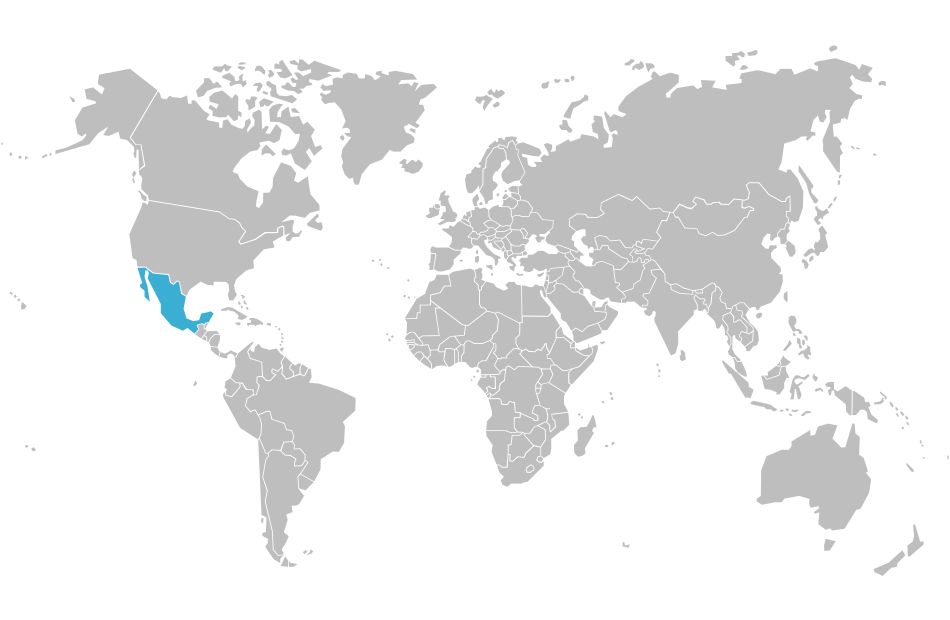
A Maya port on a cliff, a beach road under the palms, and 100 miles of flooded cave under the jungle behind it. Sleep here and a pyramid, a lagoon and a turtle bay are all inside a day.
What the days here are made of, and how far one road gets you. The light on the cliff at 7, the cold shock of the first cenote, and a highway that puts a pyramid, a lagoon and a bay full of turtles inside a single day.
The coast here is a shelf of limestone with a skin of sand on it and nothing underneath but water. That single fact explains the whole place. No rivers, no hills, no ground you can dig a foundation into without hitting a cave.
Tulum is two settlements sharing a name. The town sits on Highway 307 where the buses stop, running on tacos, laundries and dive shops. The beach road runs along the sand 2 miles east, on generators and imported everything. People argue about which one counts. Book either, because the 15 minutes between them matter far less than the road they both sit on.
That road is the point. Akumal and its turtles are 25 minutes north, Coba is 45 minutes into the forest, Chichen Itza is 2 hours inland and Bacalar is 3 hours south. What does not move is the water: cenotes at 77°F (25°C) all year, cold enough on the first drop to make you swear, and a sea that some years arrives brown with sargassum and smells like low tide.
Give it 5 nights. One goes to the walled site at opening time, one to a cenote nobody has heard of, one to the pyramid 2 hours inland, and the last 2 to the sand, because by then you will want them. Plenty of people book Tulum for the sand and go home talking about a day they spent somewhere else.
Hot all year, wet from May, and the thing that actually decides your trip is not the rain. It is what the sea brings in.
March is the driest month on the record at 1.2in (30mm), and the whole stretch from November to April sits under three inches a month. Nights drop into the low seventies, which is the only time of year you sleep without air conditioning. It is also when the sargassum is usually gone, which is why everyone comes.
Rain arrives in the afternoon and is usually done inside an hour, so the mornings still work. September and October are the wettest months at around 6.3in (160mm) and 7.1in (180mm) and they sit in hurricane season. In exchange the rooms fall to their lowest rates of the year and the cenotes are empty on a weekday.
Best time to go. November and April, the two ends of the dry season. The middle of it, December through March, is drier still and carries the Christmas fortnight and the spring break crowd with it. May to October is hotter, wetter and the cheapest the year gets, and June to August is when the seaweed is at its worst.
Boarding pass
EZ 003 · 21A
From
YOU
To
TQO
Wherever you areTulum, Mexico
Flight
EZ 003
Seat
21A
Gate
Inbox
Boards
Monthly
Send this to whoever is planning the week
Tulum is a good town and a better base. One highway runs through it, and a morning on that road puts you at a pyramid, a lagoon they named for its 7 colors, or a bay where turtles graze in waist-deep water. Here they are in the order people book them, which is not the order of a map.
5 nights gets you the pyramid, the lagoon and a morning with turtles. Everything else is what you do between them.
Almost everybody lands at Cancun and drives an hour and a half south. Since the end of 2023 there is a second door, and whether you use it decides how the first day of a trip goes.
Step one
Tulum has had its own airport since the end of 2023. Felipe Carrillo Puerto sits 16 miles (25 km) from town and takes a short but growing list of direct routes. Cancun is 75 miles (120 km) north, second busiest in Mexico, and still catches almost everything flying to this coast, which is why most people land there anyway. Check both fares. If Tulum comes within about $80 of Cancun, take Tulum and skip the drive.
Step two
Only if you landed at Cancun. 75 miles (120 km) of straight, fast highway down the coast, and what you pay for it runs from about $6 on a colectivo to about $160 in a private van. The difference is mostly patience. Out of Tulum's own airport it is a 40 minute run into town instead.
Option A · The bus
Runs from every Cancun terminal, air conditioned, luggage underneath. You buy the ticket at the counter and get on.
Option B · A car and a driver
Booked ahead, meets you with a sign, drops you at the door. The only option that works with three bags and a car seat.
Landing in daylight, travelling light? Take the ADO. It is under thirty dollars, it is comfortable, and it puts you in the middle of town. Landing late, or three of you with bags? Book a private van before you fly and be at your door in ninety minutes. And check Tulum's own airport on the way in and on the way out. It is often the same money and it is always two hours less of your life.
Pick the side of the highway first, because that decides the price, the food and how often you are in a taxi. The room is the easy part.
Areas (1/5)
The town grid
Either side of Avenida Tulum, where the bus station is and where people who live here live. Small hotels above shops, hostels with courtyards, and the cheapest beds in the whole place. Twelve minutes to the sand on a bicycle.
The beach · 12 min by bicycle, 10 by taxi
No beach attached and no pretence of one. What you get instead is a cash machine inside an actual bank, which the coast does not have.
First trip, stay and rent bicycles; second trip, take three nights on the sand and pay for the pool.
Places (1/2)
A small guesthouse on a side street a few blocks off the main avenue, run by people who answer questions properly. Breakfast in a courtyard and bicycles at the door.

Plain rooms around a courtyard, two minutes from the bus station and about five from the best cochinita in town. The kind of place that makes the town argument for itself.

A small hotel with a pool in the middle of the grid, close enough to walk to everything on Avenida Tulum and set back enough to sleep through it.

Pink, small and central, a couple of streets off the avenue. Rooms are basic and the location is the whole point.

On the road out toward Aldea Zama, with a pool and a kitchen that locals eat in. Slightly out of the grid, which cuts the street noise down.
Half of it is in fresh water you cannot see from the road. The other half is a wall on a cliff, a forest full of stone, and a bicycle.
Nothing here runs on a fixed circuit. What you buy is a morning or a day at a time, sold out of the town, off the beach road, or straight at the gate: a string of cenotes, a cave line for divers, a float through the mangrove, a bay full of turtles, a city in the forest, and, if you are willing to start before 6, the big pyramid 2 hours inland, a boat out of the city up north, or a lagoon 3 hours south that runs through 5 shades of blue. Pick one and follow it from the first stop to the last swim.

Three cenotes in one morning, in the order that puts the cold one first.
Down the rock steps in a life jacket, into water that runs back under the overhang.
You go in as a group, because a guide is the only way they let you do it. The stair down is rock and the water at the bottom is shallow enough to stand in, 77°F (25°C) like all of them and colder than that number sounds. A little way in the roof comes over and the pool keeps going back under the limestone, dark, with nobody swimming out that far. Somebody always films the first person to get in.
8 AM· north out of town on the highwayMidday· back before the heat
You have seen what the days look like. Now pick the base you want to run them from.
You will find the Mexican food you came for. Tacos al pastor off a spit at night, quesadillas, enchiladas, churros from a cart. Behind it sits the Yucatecan half of the menu, which is pork, achiote, sour orange and pickled onion and tastes like nowhere else in the country. Both are cheap in town and roughly triple on the beach road, and the best of the local cooking is gone by two in the afternoon.
Start where everyone starts, with tacos al pastor from a spit on the avenue after dark. Then order cochinita pibil, pork buried in banana leaf overnight with achiote and sour orange. It arrives on a panucho at breakfast and in a taco at nine in the morning, and the good places have sold out by early afternoon.
Look for the pink pickled onion. It is on everything here, it is habanero and sour orange, and it is the flavor people go home trying to reproduce.
Then work outward: chilaquiles before noon, poc chuc at lunch, tikin xic if there is a grill going, and churros or an elote from a cart afterwards.
Go early.
Dishes (1/16)


Pick where you are, then swipe through what is open there.
Areas (1/5)
The town grid
Where the food is. Cochinita griddles that open at seven, taco stands that go past midnight, and a bill that will not make sense after a week on the coast.
Cochinita from a griddle before nine, tacos de pescado at two, and one dinner on the beach road that you booked a week ago.

A griddle under an awning on Satelite Sur doing cochinita and lechon from early morning. The queue is locals and the good stuff is gone by early afternoon. Hours are not posted anywhere, and it does not need them.

The al pastor spit on Avenida Tulum, spinning from the evening until very late. Panuchos, salbutes and tacos at prices that look like a misprint after a day on the beach road.
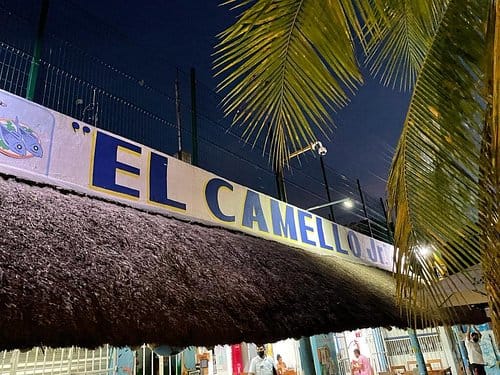
A big open room at the north end of the avenue doing ceviche, whole fish and seafood cocktails to a room that is half visitors and half families. Cash is easiest.

Burritos wrapped in banana leaf instead of foil, plus juices and coffee, in a garden off the avenue. Reliable, and the one everybody in town has eaten at least once.

A garden courtyard on the avenue running from half past seven in the morning to half past eleven at night, which covers almost any hour you turn up hungry.

Seafood on the avenue with plastic chairs, cold beer and a fish of the day. Nothing about it is styled and that is most of the appeal.

A morning place on Satelite Sur, open eight until one and then done for the day. Coffee, pastries and eggs, and it fills with people on laptops by nine.

A counter doing the local canon from half past seven in the morning to half past ten at night, seven days. Cheap, plain, and open when everything with a concept is not.

Open from nine in the morning until midnight in the middle of the grid. The kind of room that works for a late lunch and again for a last drink.

Runs from nine in the morning to two in the morning, which is the longest posted day in town. Mezcal, food, and a room that changes character three times before it closes.

Coffee from half past seven, and it stays open into the evening Thursday through Sunday and shuts at half past two the rest of the week. Read the day before you plan around it.

A charcoal grill on the north side of the grid, four in the afternoon until eleven, closed Sundays. Meat, and a room that smells like it from the street.

The one with the painted VW out front pressing sugar cane into the mojitos. Live music most nights and the whole street standing outside it by eleven.
There is no ride-hailing app here and the taxi fares are fixed high, which is the single most reliable way to spend more than you planned. Almost everything else is cheap.
The whole of Tulum Pueblo crosses in twenty minutes. Pavements come and go.
Twelve minutes to the sand on the cycle path. Lights matter after dark.
White vans on 307. Flag one down, pay the man at the door in cash.
From the station on Avenida Tulum. Air conditioned, seats booked.
Helmets are the law. Sand on the corners of the beach road.
No meters, no app. Agree the fare through the window before you open the door.
| Mode | For | Speed | Good to know | Fare |
|---|---|---|---|---|
On Foot | The town grid | Walking | The whole of Tulum Pueblo crosses in twenty minutes. Pavements come and go. | |
Bicycle | Town to the beach | Unhurried | Twelve minutes to the sand on the cycle path. Lights matter after dark. | |
Colectivo | Up and down the highway | Cheap and constant | White vans on 307. Flag one down, pay the man at the door in cash. | |
ADO Bus | The airports and the coast | Scheduled | From the station on Avenida Tulum. Air conditioned, seats booked. | |
Scooter | Cenote hunting | Quick | Helmets are the law. Sand on the corners of the beach road. | |
Taxi | Town to the beach road | Fastest | No meters, no app. Agree the fare through the window before you open the door. |
Teach a friend some Spanish
English gets you through the beach road and most of the town, and that is exactly the problem: it is possible to spend a week here and speak none. Four minutes of this changes what the taco stand is like.
Ten things worth sorting before you go. Most of them cost nothing and two of them will save you a great deal of money.
Categories (1/5)
The airport, the taxis, the seaweed, the water you can and cannot drink. Step through the topics, the marker follows you down.
Still curious? Just email us
Still curious? Just email us