Four in the afternoon and the light goes the color of weak tea. You are under an awning outside a store that sells single sachets of shampoo and cold Coke in glass bottles, and the rain comes up the street toward you like something poured out of a bucket by somebody not being careful about it. Then it arrives, and for eleven minutes nobody speaks, because nobody could be heard.
The woman running the store keeps scrolling. Two men on a tricycle wait it out with the engine switched off, one of them holding a plastic bag of fish that is going to be dinner regardless. A dog reorganizes itself under a chair. Nobody is treating this as an event.
Then it stops. Not tapers. Stops. The gutters keep running for another ten minutes and the road steams, and by five you are walking to dinner in dry clothes, faintly annoyed that you cancelled your afternoon over eleven minutes of weather.
This is the part that gets left out of the question people type into Google, which is some version of: is the Philippines worth it in the rainy season, or am I wasting the trip. The results split into two camps that are equally useless. One tells you not to go. The other tells you it is fine. Neither hands you a way to decide.
Six months is not six months of rain
The Philippine state weather bureau, PAGASA, splits the year into two blocks and does not fuss about it much.
"Using temperature and rainfall as bases, the climate of the country can be divided into two major seasons: (1) the rainy season, from June to November; and (2) the dry season, from December to May."
So June through November is the wet half. That is the whole of the useful information most articles give you, and it is where they stop, which is a shame, because the interesting part is what sits inside those six months.
The rain comes from the southwest monsoon, the habagat, which PAGASA declares open each year. It is not a continuous system. It surges and then it goes flat, and the bureau has a word for the flat part that almost nobody outside the country uses.
"But there will be periods with very little or no rain, called monsoon breaks. These monsoon breaks can last for a few days or even weeks."
Weeks. Inside the rainy season. That is not a technicality, it is the shape of the thing. The habagat is a series of soakings with long dull gaps between them, and your trip lands somewhere in that pattern whether you plan for it or not.
The storms are the other half. PAGASA publishes a seasonal outlook for the number of tropical cyclones forming inside or entering Philippine waters, broken down by month.
That number needs another one beside it, because you will meet the other one everywhere else. Yearly counts inside the Philippine Area of Responsibility run higher, because they cover a whole calendar year, quiet half included, and the figure depends on the source and how it counts. About nine storms a year cross the country. A page that gives you a yearly count and no dates is describing a year, not a season.
"With the average of 20 TCs in this region per year, with about 8 or 9 of them crossing the Philippines."
| Month | Tropical cyclones expected |
|---|---|
| June | 1 to 2 |
| July | 2 to 4 |
| August | 2 to 4 |
| September | 2 to 3 |
| October | 1 to 2 |
| November | 1 to 2 |
"Pagasa added that July to October marks the peak of the typhoon season, during which nearly 70 percent of all typhoons form."
Nine to thirteen is a wide spread, and the bureau is not hedging. It is being straight about a system that has never once filed its plans in advance.
Read the table sideways and it says something a headline never will. Across roughly one hundred and eighty days, several systems will exist. Most of those will not come near you. A handful will bring three or four days of unsettled weather somewhere in a country that runs eleven hundred miles (1,770 km) top to bottom.
Highlight
That reframing is the whole article. Everything below is either about where the bad days are less likely, or about building a trip that survives them.
PAGASA does not declare one rainy season
Here is a detail that sounds bureaucratic and turns out to be the most useful thing on this page. The bureau does not announce a national start date. It announces it by region.
"Based on the weather observations and analyses, occasional to frequent rains associated with the Southwest Monsoon (Habagat) have been observed over the past five days. This signifies the onset of the rainy season across the western sections of Luzon and the Visayas."
Western sections. The habagat blows in off the South China Sea and dumps on whatever faces it, which means Manila, the west coast of Luzon, Palawan, the western seaboard of the Visayas. Islands inside the Visayas are a different case: Cebu sits in the shelter and peaks at about 7.6 inches (193 mm) in its wettest month against Manila's 17.4 inches (441 mm). East-facing coasts are not in that sentence either, because their wet months are the opposite half of the calendar, driven by a different wind.
So a country-wide verdict on June through November is meaningless. The month that soaks one island is the month another island is at its driest.
West-facing (Palawan, Manila, western Visayas seaboard)
- Wet months roughly June to October
- Rain arrives as afternoon and evening downpours
- Dry window sits November through April or May
- Sea state is the usual reason a day gets cancelled
East-facing (Bicol, Eastern Visayas, east Mindanao)
- No pronounced dry season at all
- Wettest stretch falls December to February
- Takes the first hit from systems tracking in off the Pacific
- June to September can be the better half of its year
Storms make their own geography on top of that. PAGASA describes the tracks plainly: systems form out near the Marianas and the Carolines and move northwest across the archipelago, which is why the far south sees fewer of them.
"Their movements follow a northwesterly direction, sparing Mindanao from being directly hit by majorty of the typhoons that cross the country."
Bicol and the Eastern Visayas sit in the doorway. Palawan sits off to the side of the main corridor, at an angle to most of the traffic. That is a tendency and not a promise, and any given storm can turn, which is why the answer to "is Palawan safe in August" is always the current bulletin and never a general rule.
Where northwestern Palawan lands in all this
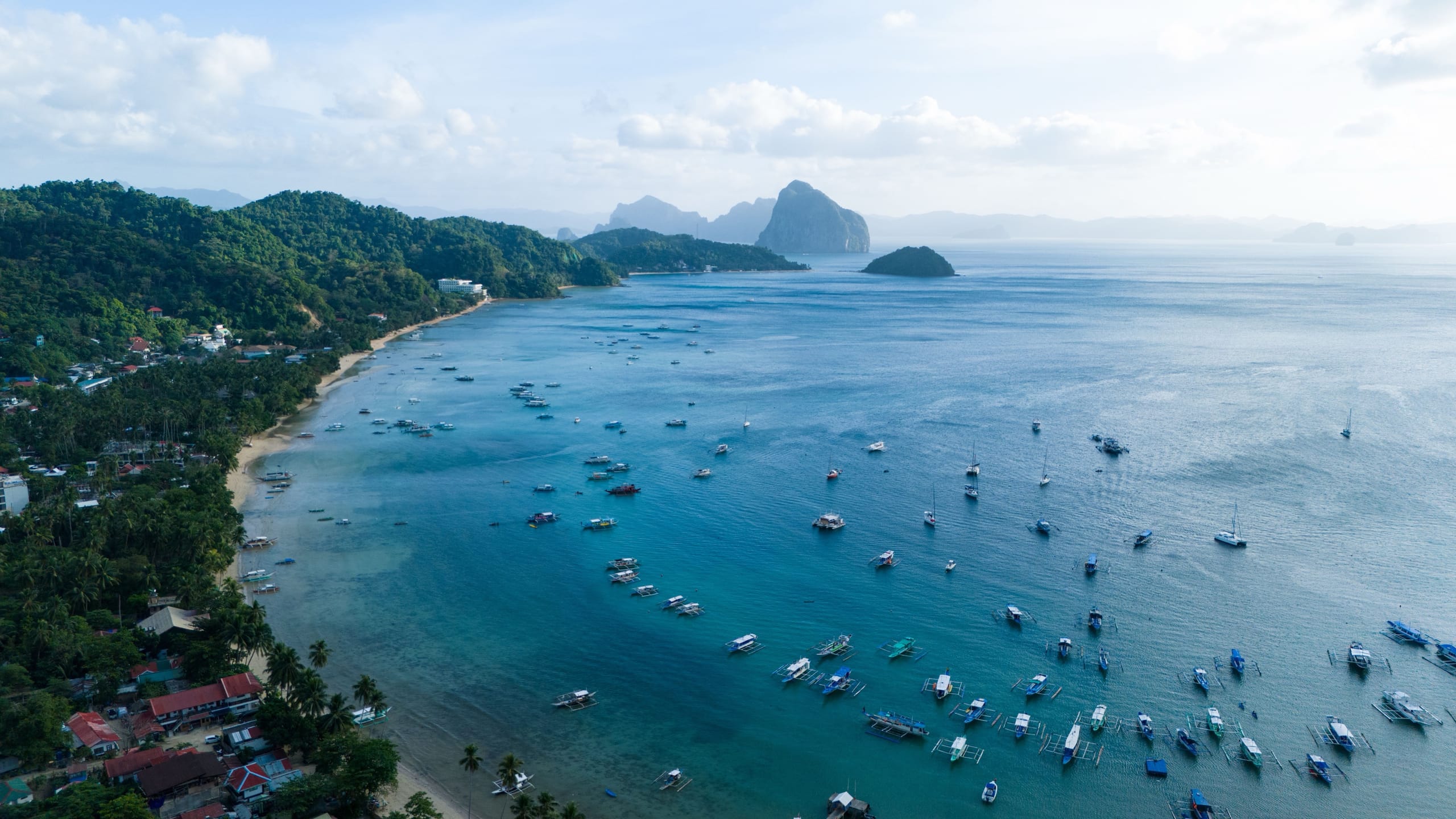
The limestone end of Palawan runs its dry window from roughly November into May, with the heaviest rain landing June through September. If you are looking at the El Nido side of the island, that is the window the town runs on, and it is why boats, guesthouses and tour offices all behave differently on either side of it.
What that means in practice is a town with two personalities. In February the boats go out every morning without anyone thinking about it, the tour offices are competing for you, and the beachfront is loud until eleven. In August the same street has half the boats, a third of the people, and a rhythm set by whatever the water is doing that day. Some of the smaller operators close for a stretch. The ones that stay open are the ones that live there.
Which does not mean the wet half is closed. It means the wet half runs on different rules, and the rest of this is those rules.
The 2026 complication nobody's evergreen guide has
Every article about Philippine weather is written once and left alone. This year that is a problem, because in June the bureau said something that changes the read.
"El Nino typically increases the likelihood of below-normal rainfall conditions across much of the country, raising the risk of dry spells and drought, particularly in vulnerable areas. However, above-normal rainfall conditions may still occur, particularly over the western sections of the Philippines during the Southwest Monsoon (i.e., Habagat) season, especially when enhanced by tropical cyclone activity."
Two things at once. Nationally, drier than normal. On the western side, which is the side with the beaches most people are flying in for, potentially wetter than normal when a storm is out there feeding the monsoon.
So the tidy takeaway that an El Nino year means a dry trip is exactly backwards for Palawan and the west coast. It is right for the country as an average and wrong for the specific islands you booked. Averages are a poor guide to a two-week trip.
An El Nino year does not hand you a dry Palawan. It hands you a drier country with a wetter west edge.
What you give up
Boat days, mostly. That is the cost that bites, and it is close to the only one.
The wind does not read your booking confirmation. It has no view on how far you flew or how many days you have left, and the boat crew who tell you at seven in the morning that today is not happening are not negotiating. What they are reading is a gale warning over that water, and it is usually up the night before you get told. When the Coast Guard cancels the boat covers who issues it and what it does to your money.
Island hopping in this part of the world runs on outrigger boats with a low freeboard and no shelter to speak of. They are steady in a swell and miserable in a chop, and the decision to run or not is made in the morning by people reading the water and the bulletin. When the wind gets up, the day does not happen. Not because anyone is being cautious for the sake of it.
"Accidents are more frequent during the rainy season between June and December when storms can develop quickly."
Take that at face value. A boat that goes out on a bad morning is worse than a boat that stays in. If you have already worked out which island-hopping tour suits you, understand that in July or August the letter you picked matters less than whether the sea lets anybody out at all.
Most August days on the west coast do go out. It is the one that does not that you plan around, which is why two island-hopping days booked in a row is a better bet than one, and five is close to certain.
The second thing you give up is water clarity. Heavy rain puts runoff into the bays, and rivers push silt out over the reef. Snorkeling goes from glass to something like weak tea for a day or two after a hard soaking, then recovers. Divers plan around it. Snorkelers usually find out about it while already in the water.
Third, the tight connection. This is the one that ruins trips. Not rain. A schedule with no slack in it, meeting a two-day wind advisory, on the leg where a missed boat means a missed flight means a missed flight home.
What you get
Space, first. The lagoons in low season have four boats in them instead of forty, and you can hear the paddle. Guesthouses that were full in January have rooms. Tour offices will still run with three people in the boat, which in high season would be a private charter.
Fares soften too. Fares often soften in the low season. If you are working the fare side of this, the usual tricks for finding a low fare apply here more than usual, because the airlines are discounting into weak demand.
Then there is the landform itself, which is a different thing wet. Rice terraces hold water and reflect. Waterfalls that are a damp streak in April are loud in August. The hills that look scorched and beige in the dry months go a green that is difficult to describe without reaching for words the internet has ruined.
And the light after a storm passes is the best light of the year. Everything washed, the dust knocked out of the air, the horizon suddenly a hundred miles deep. It lasts about forty minutes and then the sun goes down.
The full arithmetic of what a trip here costs sits in the breakdown of two weeks of spending, and low season shifts most of the movable lines in it downward.
Where to base yourself when the weather has a vote
In the dry months you can stay anywhere and get away with it. In the wet months your room becomes infrastructure, because you are going to spend more hours in it than you planned, and where it sits decides whether that is pleasant or grim.
The thing to look for is walkability. A room ten minutes on foot from somewhere to eat is a different proposition from a room that needs a tricycle in both directions, once the tricycles have stopped running because the road is a stream. Beachfront looks best on a screen and is the first thing the wind reaches. A place set one street back, with a covered terrace and a fan that works, is the one you will be glad about at four in the afternoon.
For a trip built around boats, stay in the town rather than out at a cove property. Cove properties are lovely and they are also dependent on a boat transfer that gets cancelled by the same weather that cancelled your tour, which is how people end up stranded somewhere beautiful with a flight to catch.
Two more things that matter more than they should. Ask whether the property has a generator, because brownouts follow storms and a night without a fan in ninety percent humidity is a long night. And filter for free cancellation before you filter for anything else, then book early anyway. Wet-season rooms are easy to find and the good ones are not, and a cancellable booking costs you nothing to hold.
The rule that decides it
Not a weather rule. A structure rule. You cannot control whether a system parks off the coast during your trip, and you can control every one of the following.
Put a slack day beside every island move. One buffer day per hop. If you are going Manila to Palawan to somewhere else, that is two spare days across the trip, and they are the cheapest insurance you will buy. They also give you the thing nobody plans for and everybody wants, which is a day with nothing in it.
Never fly home the day after your last boat. Give the international leg a full day of air, in the city with the airport, in a room you already paid for. If nothing goes wrong you get a slow morning and a market. Worth being accurate about why, because this article has spent a long time blaming the sky and the sky is not the whole story. Domestic flights here get delayed and cancelled in every month of the year, and long-time residents will tell you congestion in Philippine airspace does at least as much of that as weather. International services generally keep to their timetable. So the day of slack is not wet-season advice at all. It is advice about the domestic leg, and the wet season only makes a thing that was already true more likely.
Book rooms you can cancel and tours you can move. Free cancellation costs a few dollars a night and buys the ability to change your mind at 7am when the wind is up. Tour operators in the wet season are generally happy to move you to the next fine day, because they would rather run a full boat on Thursday than a half boat on Tuesday. Ask before you pay, not after.
Buy the policy on the day you make the first non-refundable payment. This is the one people get wrong. Weather cover works on what was foreseeable when you bought, so a policy bought after a storm is already named and tracking is a policy that will not pay for that storm. If the mechanics of that are new to you, how the cover is structured is the background.
"Your travel insurance could be invalidated if you travel against advice from the Foreign, Commonwealth & Development Office (FCDO)."
Learn the airline's disruption rules before you need them. Domestic carriers here handle weather cancellations through a self-service portal rather than a queue at the airport, and the terms are more generous than most people expect and more final than most people realize.
"Rebook your flight for free up to 30 days before or 30 days after your original schedule."
The airline's own page also says that once you pick rebook, refund or travel credit, the choice is final and cannot be undone. So when the notification lands at 6am, do not tap the first button. Find out when the next flight with seats leaves, then choose.
Pros of Going in the June to November window
- Fares and rooms at their lowest point of the year
- Lagoons, viewpoints and boats with a fraction of the peak-season load
- Waterfalls and green hills that do not exist in the dry months
- Monsoon breaks of several days or weeks are normal, not lucky
- Free cancellation and flexible tour dates are easy to get, because operators want the booking
Cons of Going in the June to November window
- Boat days get called off, and the sea decides, not you
- Water clarity drops for a day or two after heavy rain
- A tight itinerary has nowhere to absorb a two-day wind advisory
- Manila floods, and a flooded Manila can eat a transit day
- Some smaller operators close entirely for part of the low season
Packing for water arriving from every direction
You will get wet from above, from below, and from the inside, because the humidity does not let anything dry. Cotton stays damp for two days. Plan around that rather than fighting it.
What earns its space in the wet half of the year
Clothes
- Two quick-dry shirts, worn in rotation, washed in the sink
- One long-sleeve layer for air-conditioned buses, which run arctic
- Sandals that survive being soaked, plus one dry pair kept dry
- An umbrella, because the afternoon rain mostly falls straight down and everybody who lives there carries one
- A light rain shell for the windy days, not a poncho, because a poncho in wind is a sail
Keeping things dry
- A roll-top dry bag, 10 to 20 liters, for the boat
- A dry pouch for phone and passport that seals
- Two or three zip bags for cables, cards and anything paper
- A microfiber towel that dries faster than the air
Power and connection
- Power bank, charged, for brownouts after a storm
- Universal adapter, since outlets vary building to building
- An offline map of the island downloaded before you leave the city
Staying connected when the weather turns
Data matters more in the wet season than the dry one, because the decisions are all last-minute. Whether the boat runs, whether the flight moved, whether the advisory went up overnight. Sort it at the airport. The choice between an eSIM and a plastic SIM from a counter is worth two minutes of thought before you fly.
For tracking, the bureau publishes bulletins directly, and the long-running enthusiast tracker at typhoon2000.ph ↗ is faster to read on a phone. Local Facebook pages for boat operators are, oddly, the most current source of all for whether a specific route is running.
What a wet afternoon does to a day
Rain reorganizes the schedule rather than cancelling it, and the reorganized version is often better.
The covered market becomes the plan. Fish laid out on ice with the water running off the tables, women shouting prices that drop as the afternoon goes, the smell of cut calamansi and wet concrete and something frying. You end up eating at three in the afternoon because you were stuck somewhere with a carinderia in it, pointing at two trays and getting rice.
This is where the food gets good, incidentally. The wet season is not a food season in any tourism sense, but it is when you end up in the places that are covered and cheap and full of people who work nearby. Sinigang makes sense in the rain in a way it does not in April. So does the tiny cup of terrible instant coffee that comes with it.
Halo-halo is the other one. Shaved ice, evaporated milk, and a filing cabinet of unrelated sweet things at the bottom. Nobody has ever explained to me why it is a monsoon food. It is.
Afternoons empty out. From about two to five in a coastal town in August, there is nothing to do and nobody doing it, and if you can stop resenting that you have found the actual texture of the place.
What surprises people
It does not rain all day. That is the biggest one. It rains hard, for twenty minutes or two hours, usually in the afternoon or overnight, and then it is over and the streets dry in an hour.
I sat out a downpour once for fifty minutes under an eave, refreshing a radar app, waiting for a break in the yellow. The break had come and gone at minute twelve. I was looking at a picture of the rain instead of the rain, which was about a meter away and had stopped.
The heat is worse in the dry season. April and May are the ones that flatten people. August is cooler, cloudier and easier to walk around in, and the sea is warm enough that nobody notices the difference.
The dry season has its own wind. From roughly November into February the northeast monsoon, the amihan, comes down the other side of the country. Booking January does not buy you a guarantee. It buys you better odds.
And the thing that wrecks a trip is almost never a typhoon. It is a two-day stretch of unsettled weather landing on a five-day itinerary with no give in it. The storm makes the news. The itinerary does the damage.
- A single-island trip with a long stay absorbs weather. A four-island sprint does not.
- The best low-season weeks are usually late September into November. Read that alongside the table above rather than instead of it.
- June is often gentler than its reputation, because the monsoon is still finding its feet.
- Whatever you book, book the sea day early in the stay so there is room to try again.
How long to go for
Twelve days is the number where the weather stops mattering much. Long enough that a bad two days is a bad two days rather than the trip. Anything under a week in the peak months is a bet, and it can come off, and you should know you are placing one.
The other length rule is stops, not days. Each island you add costs you a travel day and a weather exposure, and in the wet season that compounds. Two bases in two weeks reads as unambitious on paper and works out better on the ground than four.
The costs people forget in this window are the reroute costs. The extra night when the boat does not run, the van you take because the flight moved, the tour you paid for and could not use. Budget a couple of hundred dollars for that category, treat it as the price of the low fares, and be pleased if you finish the trip without touching it.
If you are flying into Palawan at all, the route in has changed and it is worth reading how the approach to the north of the island works now before you book the connection, because the wet season punishes tight connections harder than anything else on this page.
Safety, straight
Three things, delivered without decoration.
Water first. Do not get on an overloaded boat, in any season. Look for life jackets before you step on, and if the crew is arguing about the weather among themselves, that is your answer. A cancelled day costs you a day. There is no version of this where pushing is smart.
Flooding second. Metro Manila floods during heavy habagat, and it can disrupt travel. If your transit day runs through Manila in July or August, allow for it, and do not schedule anything that depends on crossing the city in a fixed window.
Advisories third. The UK foreign ministry advises against travel to parts of Mindanao and the Sulu archipelago for reasons that have nothing to do with weather, and travel against that advice can void your insurance, which is a separate and expensive problem. The general question of how to read these things without either ignoring them or panicking is covered in the piece on assessing whether somewhere is safe.
Weather cancels days. Bad structure cancels trips.
On the last afternoon it rained again, which by then was not information. The boat had gone out that morning and come back early and nobody minded. The town did what it does at four o'clock, which is stop.
You spend a while under an awning next to a man who is also waiting, and neither of you says anything, and it goes on longer than either of you expected. Then it eases. The gutters keep running. Somewhere down the street a generator starts.
Whether that reads as a wasted afternoon or the best hour of the week is the actual question, and no forecast is going to answer it for you.