If you found a round-trip flight to Malé and are wondering whether the Maldives could work on a modest budget: the short answer is yes, but it requires understanding what kind of Maldives you're signing up for. The first ferry out of Malé leaves at six in the morning. You're sitting on a blue plastic bench at the public terminal, still adjusting to being awake. Around you, workers are checking phones. A family has arranged themselves with a large cooler and several bags. The sea is flat, the light still grey and low, and no one seems particularly moved by any of it.
This is not the Maldives you've seen in photographs.
There's no infinity pool. No overwater bungalow breakfast tray. No couple in white linen walking toward the camera at golden hour. Just diesel smell, a water taxi cutting across the harbor, and the mild institutional chaos of a ferry terminal where the departure board only sometimes reflects reality.
It's a different Maldives, not a lesser one.
- Local islands, not resorts, are the actual budget option. Guesthouses have been legal there since 2009, with basic en-suite rooms starting at a modest nightly rate (check current prices).
- There's a legal floor to how cheap this trip gets. The law recognizes only resorts, hotels, guesthouses and vessels as places to sleep for money, so there's no hostel, dorm or campsite to drop to.
- Every arriving traveler must file a free IMUGA Traveller Declaration in the 96 hours before the flight. There's no visa, but that form isn't optional.
- Shoulder season cuts flight costs hard. Flying into Malé in early May can mean a noticeably lower round-trip fare from Europe than in January.
The Two Maldives
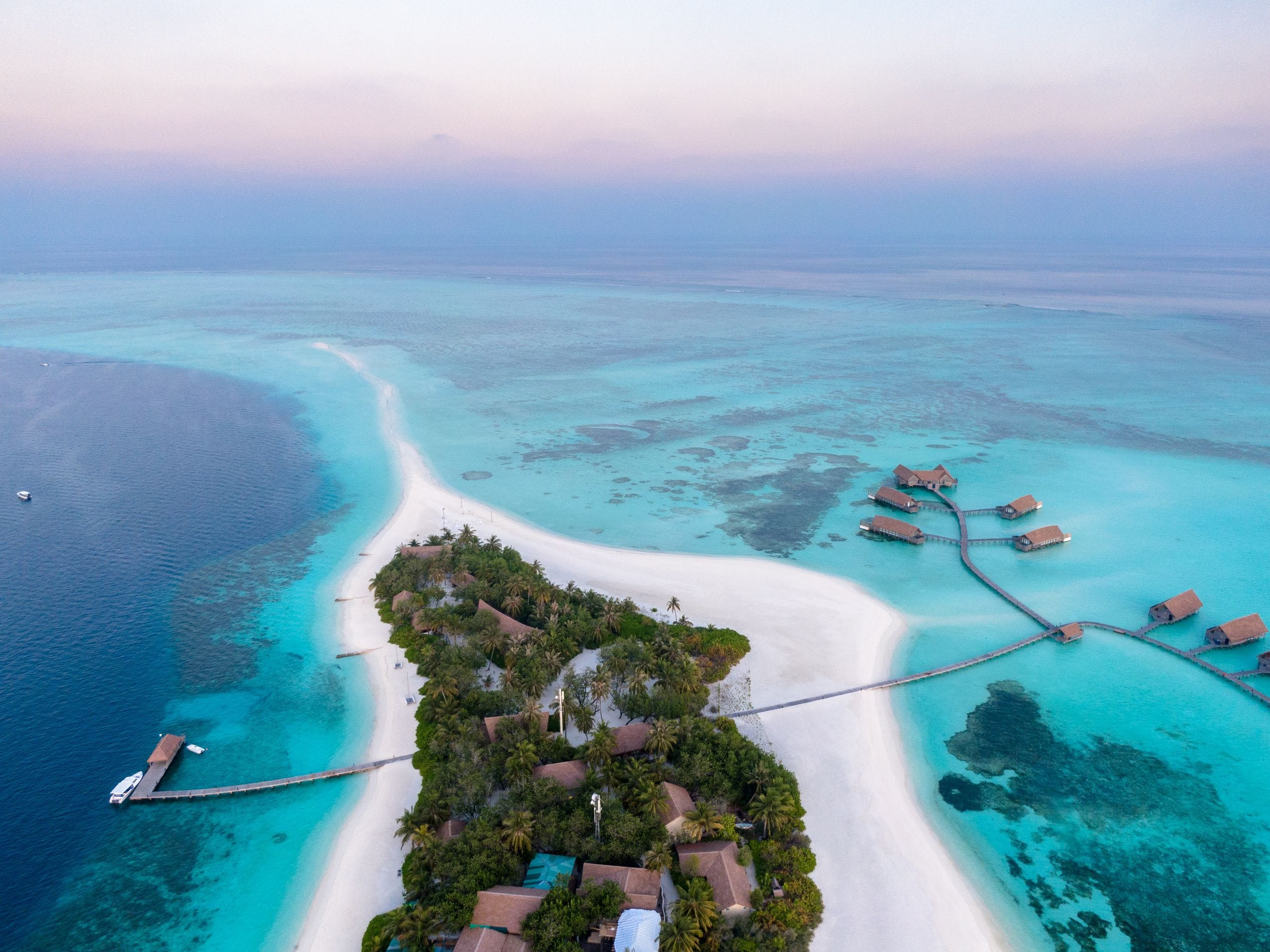
The country is made of roughly 1,200 islands, only a fraction of which are inhabited by Maldivians. Over 100 more are designated resort islands, each leased to a single resort, accessible by seaplane or speedboat, operating as a self-contained miniature economy where guests rarely, if ever, leave the property.
The resort system is how most people experience the Maldives. It's also how most people price it. A week in an overwater villa costs thousands of dollars per person before food and alcohol.
The local islands are different. Since 2009, the Maldives has allowed guesthouses to operate on inhabited islands. A relatively recent policy shift that opened an entirely different kind of travel. You stay in small family-run guesthouses, eat in local cafes, take public ferries between islands, and move through a country that is functioning rather than performing paradise for visitors.
Budget accommodation on local islands starts at a modest nightly rate for a basic en-suite room, rising for something nicer with sea views or air conditioning that works reliably. Add local food on top and the day rate lands where the breakdown further down puts it. That is still money. But it's a different universe from the resort price structure.
That number does not go any lower, and this is the fact that separates the Maldives from every other cheap country you have been to. The law recognises four kinds of place a tourist may sleep for money: a resort, a hotel, a guesthouse, or a vessel. Hostel, dormitory and campsite appear nowhere in it.
There is no bunk to drop to when the budget gets tight, no beach you are allowed to pitch on, and no couch-surfing economy under the guesthouses. The floor of this trip is a private room. Plan the whole thing from that number upward rather than hoping to find something under it.
"No tourist shall be provided accommodation for payment in any establishment other than a tourist hotel or tourist guesthouse registered and licensed under this Act or a tourist resort or tourist vessel licensed under this Act."
Getting There
Malé is the entry point for almost everyone. Flights from Europe typically route through Doha, Dubai, or Colombo and take 10 to 13 hours. Prices vary enormously depending on season. January through March is peak. Dry months, best visibility, highest fares. Late April and May are cheaper and still mostly dry. The rainy season runs June to November; prices drop, some guesthouses close, and weather can be rough enough to matter.
There is no visa to apply for and there is a form you cannot skip. Every arriving traveller has to file a Traveller Declaration through the government's IMUGA portal, electronically, free, in the 96 hours before the flight. Everyone means everyone, including the baby on your lap.
You present the completed declaration at immigration when you land. It takes a few minutes and it is the one piece of admin between a booked flight and a stamp in the passport, so do it the evening before you fly rather than in the queue. The clock that matters starts the moment you clear immigration, because getting from the airport to a local island is decided by a boat that leaves once a day.
"All foreigners arriving in the Maldives must complete and submit the 'Traveller Declaration' form. The form can be completed up to 96 hours (4 days) before your arrival in Maldives. Submission of the form is free of charge and must be filled electronically via the IMUGA portal."
If you're flexible with timing, shoulder season offers the best balance. Flying into Malé in early May, you might find noticeably lower return fares from Europe than in January. Watch for several weeks before committing.
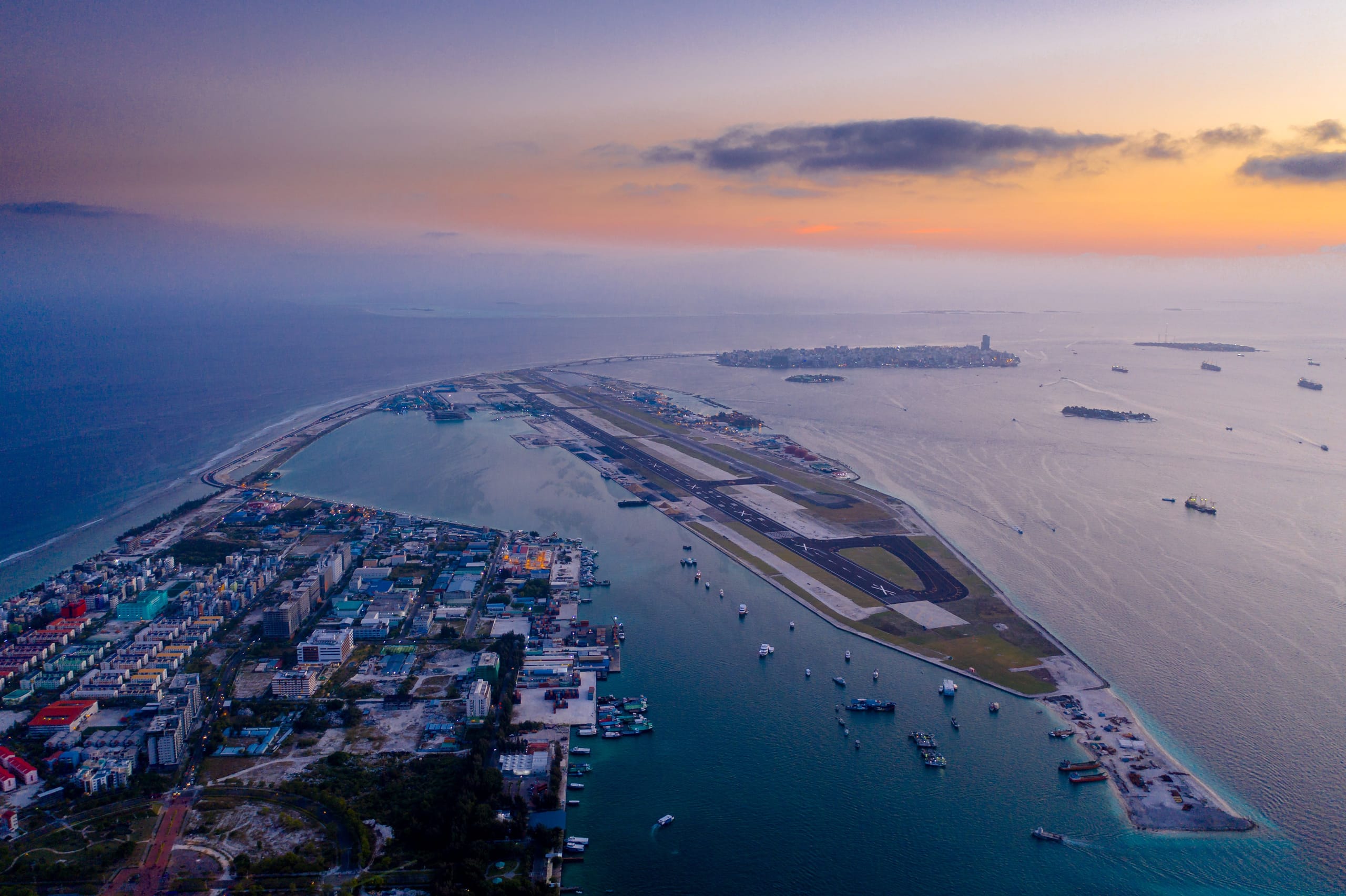
The Malé airport sits on Hulhulé Island, connected to the city by the China-Maldives Friendship Bridge, completed in 2018. If you're heading directly to your island, you'll bypass Malé and transfer by speedboat or ferry from the airport side. If you're spending a night in Malé first, which most budget travelers do, the ferry across to the city is a short hop.
Malé: Useful but Not the Point
Most budget travelers spend a night or two in Malé before dispersing to islands. It's practical rather than beautiful. Dense, crowded, functioning more as a commercial hub than anything meant for visitors.
The fish market operates from around 5am and is worth seeing. It is alive in a way most tourist experiences aren't. Tuna are unloaded fast. Everything smells sharp. The men work quickly and with no particular interest in being observed.
The streets around the old port have cafes serving short eats: local snacks, tea, fried things. Cost almost nothing. Order a ginger tea and a few snacks and you'll spend very little. These cafes are also one of the few places you'll consistently find Maldivian food rather than food adapted for tourists.
Malé is a conservative Muslim city. Dress modestly when you're off the beach islands, which means practically everywhere here. Swimwear on the street reads as disrespectful and you'll feel it.
Money, before you leave Malé
Sort this out in Malé, because the options thin out the moment the ferry leaves. Machines on the local islands dispense rufiyaa and nothing else, and rufiyaa taken out of one cannot be changed back into dollars on the way home, so draw what the next stretch needs rather than what the week might. US dollars are taken almost everywhere a visitor spends: guesthouses, excursions, the boat. Cards work in Malé and at the larger guesthouses, often with a surcharge on top, and the small places on the small islands do not take them at all.
Dollars travel. Rufiyaa does not leave with you, so draw what the next few days need and no more.
- Bring small US bills. Ones, fives, tens and twenties, for tips, short eats and the boat-fare purchases where nobody has change for a fifty.
- Draw rufiyaa in small amounts. What you do not spend cannot be exchanged back when you leave.
- Expect a possible surcharge on card payments at guesthouses, and expect the smallest ones to be cash only.
- Do the withdrawing in Malé or at the airport rather than assuming the island you picked has a machine that likes your card.
The general version of that arithmetic, the fees stacked on a withdrawal and the screen that offers to convert for you, is in what your money costs abroad.
"ATMs on local islands typically dispense only Maldivian Rufiyaa."
The Ferry System
Getting between islands on a budget means understanding the public ferry network. It's cheap and necessary, but slow and infrequent enough that you plan your days around its schedule, not the other way around.
Public ferries run once or twice a day on popular routes, on a fixed schedule, so check the departure time for your own route rather than assuming a morning boat. They cost less than a speedboat. They are slow. The same crossing a speedboat covers in 40 minutes might take three hours on the public ferry. But they carry local people going about their lives, and this makes them interesting in a way speedboats are not.
The speedboat network is faster and more flexible. Also more expensive. Most guesthouses can arrange transfers, priced by distance. Split that between two or three people heading the same direction and it stops feeling like a splurge. Alone, with a reliable public schedule to work from, take the ferry. Which of the two you can catch depends on when your flight lands, and the run from the airport to a local island lays the arrival hours against the boat times.
The key limitation of the public ferry system is the schedule. Public ferries do not sail at all on Friday, the weekly holiday, which reflects local patterns rather than tourist demand, a different thing from a timetable built for visitors. On some islands, one boat every two or three days. And the days are fixed rather than daily.
The Malé to Maafushi to Fulidhoo boat goes on Sunday, Tuesday and Thursday, and the return from Fulidhoo goes Saturday, Monday and Wednesday, which is typical of the network rather than unusual in it. Nothing runs on Friday at all. So the ten days you have do not contain every route you might want in them, and moving on when you feel like it does not work here.
The ferry timetable is not something to work around. It is the itinerary, and you write the trip inside it.
Download the ferry schedules before arriving. MTCC, which runs the boats, publishes them at mtcc.mv, and atolltransfer.com puts the same network into a route browser that is easier to read on a phone. Guesthouses are usually helpful about it too. What none of them will do is sell you a ticket: there is no online booking on the public network. You buy at the terminal office in Malé, and on every other island you pay when you board. It's just not always assembled somewhere obvious.
"There is no online system. From the other islands (not Male), you will simply pay once you board the Maldives public ferry."
For connectivity between islands, load an eSIM before you leave. Coverage in Malé and the larger inhabited islands is reliable. On smaller, more remote islands it gets patchy. Having data you can count on for maps, ferry schedules, and messages home removes one thing to be anxious about, and the ferry schedule is the one you will check most. A travel eSIM covers the Maldives and sets up in a few minutes.
Choosing Your Islands
With around 200 inhabited islands, the choice looks overwhelming. In practice, most budget travelers visit a small cluster: Maafushi, Dhigurah, Fulidhoo, Guraidhoo, Thoddoo, sometimes Mathiveri or Ukulhas.
That cluster is not an accident of taste. It is everything within a few hours of Malé by boat, which is what the transport line in the budget below is priced against.
Go outside it, to the far north or the deep south, and the boat stops being an option: those atolls are reached by a domestic flight and then a speedboat, or by seaplane, and transfers on either cost noticeably more, so check current operator pricing. That is more than this whole trip spends on getting between islands. The 200 inhabited islands are not 200 equally reachable islands, and the difference is the size of a second flight.
"Seaplane: $450-$800 per adult return. Domestic flight + speedboat: $450-$700 per adult return."
Maafushi is the most developed local island for tourism, which makes it the easiest and the busiest. There are dozens of guesthouses, several dive schools, restaurants that have figured out how to cater to Western tastes, and a social scene in the evenings. For a first visit it's comfortable. For someone who's been before, it can feel slightly processed.
Dhigurah is longer and narrower than most inhabited islands, with a sandbank at one end that's known for whale shark sightings. Quieter than Maafushi, fewer guesthouses, which means booking further ahead.
Thoddoo is known for fruit farming. Unusual in the Maldives, where most food is imported. It has a slower, more residential feel than most local islands, and the watermelon is worth trying.
Fulidhoo is small enough that you'll learn the whole island in a few hours of walking. A handful of guesthouses, a reef close to shore, and in the evenings the center of social life is essentially a single tea shop.
Don't try to see too many. The temptation is to island-hop aggressively, but the ferry schedules and the pace of local life work against this. Two or three islands over ten days feels much more settled than five.
The Bikini Beach Reality
Every local island that caters to tourists designates a bikini beach. A specific stretch of shoreline where guests can wear swimwear. The rest of the island is conservative, and this applies to both men and women, though expectations run somewhat stricter for women.
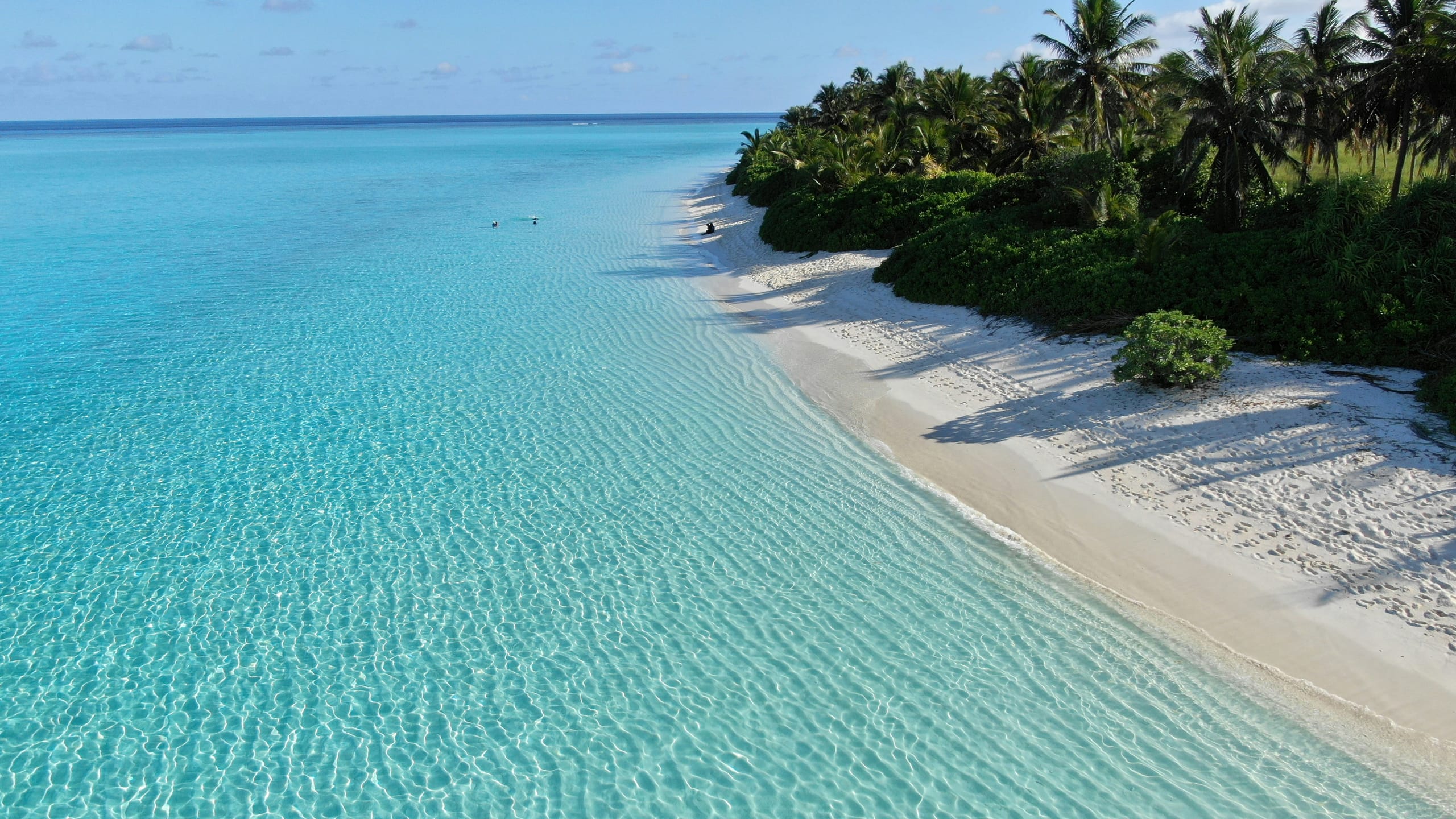
In practice, the bikini beaches are usually pleasant. Often a short walk from the guesthouse, sometimes enclosed on two or three sides, occasionally with a small cafe or rental stand nearby. They're shared with other tourists rather than locals, who swim separately in their own areas if they swim at all.
This setup produces an occasionally strange atmospheric quality. The water is warm and clear, the light is good, and the boundary between where you can be in a swimsuit and where you can't is sometimes marked by nothing more than a rope and two posts. Some travelers find the clarity liberating. Others find it mildly odd. Both reactions are reasonable.
If beach swimming is important to your experience, ask about the bikini beach before booking. Some are right on the water. Some are a ten-minute walk on a hot road.
Food and Eating
Food on local islands is the area where budget travelers face the most adjustment.
Maldivian cuisine is good. Tuna appears in almost everything: curries, short eats, rice dishes. Mas riha, a tuna curry with coconut milk, is warming and more complex than it sounds. Garudhiya is a light tuna broth served with lime, onion, chili, and rice. Both are cheap and worth eating at every opportunity.
The problem is variety. On smaller islands, restaurant options are limited. Often one or two guesthouse kitchens and a single local cafe. If you eat breakfast, lunch, and dinner on a small island for five days, you'll encounter repetition. Bring snacks. This isn't a complaint, exactly. Just an accurate expectation.
On Maafushi and the more developed islands, you'll find restaurants serving pasta, sandwiches, grilled fish, burgers. Familiar food, priced higher because the ingredients are imported. A meal at a local cafe costs noticeably less than the same meal at a tourist-oriented restaurant, which is the whole story of eating here.
There's no alcohol available on local islands. The Maldives is a Muslim country and alcohol is not legal on the local islands. If this matters to your trip, knowing it before you arrive is better than discovering it on your first evening when you ask for a beer and receive a polite explanation. And do not solve it by packing one. Bringing alcohol into the country is illegal, duty free bought on the way included, and it is taken off you at Velana on arrival.
The same goes for pork and for religious items of any non-Islamic faith. Nobody is arrested over a bottle of wine. You simply do not have it any more. Fresh juices, coconut water, and tea are everywhere and generally better than what you'd find at a resort anyway.
Diving and Snorkeling
The reef system is extraordinary. This is one of the best places in the world to dive, and even casual snorkelers meet marine life that would be the story of the whole trip somewhere else.
Dive schools operate on most developed local islands. A two-tank dive at local island operators varies by operator, so check current dive center rates. Considerably less than the same dive through a resort. If diving is your primary reason for being here, the quality underwater is not exaggerated. Manta rays, whale sharks, reef sharks, enormous turtles, walls of fish in formations that seem improbable. All of it is there.
For snorkeling, most guesthouses rent equipment for a dollar or two a day. House reefs vary by island. Some are steps from the shore, some need a boat ride, and the difference decides how much snorkeling you get. Ask before booking if the reef is your main reason for coming.
Guided snorkeling trips by boat to specific reefs, sandbanks, or marine life locations run $20–$40 per person. The whale shark excursion off Dhigurah is a different product at a different price, and it is worth separating the two before you plan around them: booked through a local guesthouse it costs more than a standard snorkel trip, so check the price and what is included, and through a resort it is more again.
The whale sharks here are a resident population, seen on most trips in every month of the year, though water clarity varies by season, so ask your guesthouse what to expect. One of those trips takes a third of the activities line in the breakdown below, so budget it as its own thing rather than as one more snorkel.
What Budget Travel in the Maldives Costs
A ten-day trip from Europe, broken down. The flight line is a shoulder-season fare, so read the whole table as the late April or May trip rather than the January one:
Ten days on local islands, one person
Every one of those bands moves. Flights swing on season and on how early you book. The accommodation line is $40–$80 a night for a decent guesthouse room, not the cheapest bed on the island. Food assumes you eat mostly local with the occasional tourist restaurant thrown in, which is $25–$45 a day. Transport means public ferries where the schedule allows and a speedboat where it does not, and activities are the widest swing of the five: skip the diving and that line drops to its floor.
Three charges ride on top of that accommodation line, and whether they are already inside your quote depends entirely on where you booked. Green tax is charged per person per night and the rate depends on the type and size of the property, so confirm the current rate with your guesthouse.
Then TGST. Add a service charge of about 10 percent, which can apply to guesthouses as well as resorts. A booking site usually shows all of it folded into the price. A rate quoted directly with two plus signs after the number does not.
Total for ten days, solo: roughly $1,500–$2,700, depending on season, choices, and how much you move around. This is dramatically less than a resort week. It's not cheap by Southeast Asia standards. The Maldives, even on local islands, is a mid-range to aspirational budget destination.
Read the total as one person in one room, because the room does not halve when a second person shows up and most of the rest does, which is the arithmetic behind doing this trip on your own. Run it the other way for a couple and the $400 to $800 room line splits between you while flights, food, green tax and excursions do not, and the speedboat charter splits per boat rather than per head. Two people land somewhere near $1,300 to $2,300 each rather than double the solo figure.
| Solo | Couple, per person | |
|---|---|---|
| Total for ten days | $1,500 to $2,700 | $1,300 to $2,300 |
Travel insurance is worth having here more than most places. Medical facilities outside Malé are limited, and evacuation from a remote island in case of a diving accident or serious illness is both possible and expensive without coverage. It's worth sorting before you go. Rolling travel medical insurance is where a lot of independent travelers land, mostly because the cover renews by the month rather than against a fixed pair of dates, which suits a trip whose end date moves with the ferry schedule.
Read the evacuation limit on whatever you buy rather than the headline number, because that is the line this place tests. What a travel policy covers goes through which parts of a policy pay out and which quietly do not.
What Most Articles Don't Mention
The Maldives is a strange place to travel on a budget. Luxury tourism has shaped how the whole country looks and how it is put together.
You'll snorkel over reefs of startling beauty and surface to see a resort island in the middle distance. One of those places where a seaplane lands every morning and the guests never leave. The contrast isn't dramatic or upsetting. It's just present. You're in a country that has organized itself largely around the provision of paradise to wealthy foreigners, and you came in through the side door.
The local island tourism is genuine and valuable. Maldivians benefit economically. Guests have a good time. But there's an occasional quality that budget travelers notice here, a sense that the country's most spectacular natural assets are technically accessible to everyone but built for a different market.
The best antidote is simply to slow down. Sit on the jetty in the early morning. Walk the interior streets of an inhabited island. Eat at the place the locals eat. Take the long ferry instead of the speedboat. The country reveals itself differently at that pace. Not worse. Just less produced.
When to Go
The dry northeast monsoon runs November to April. January and February offer the best weather, least rain, and clearest water. Also the most expensive flights and accommodation.
March and April are still dry and warm. May is transitional. Some rain, occasional rough seas, prices beginning to drop. The southwest monsoon, June to October, brings heavy rain, higher seas, and some days that are difficult. Diving visibility can drop. Some guesthouses partially close. Rates are lower, but the experience is more variable.
One thing sits on top of the weather calendar and moves every year. Ramadan runs for twenty nine or thirty days and in 2027 it may begin around 8 February, which lands it squarely in the window this section has been recommending. On a resort island nothing changes. On an inhabited island, which is where you are staying, you do not eat, drink or smoke in public during daylight for the month, and that is a law rather than a courtesy.
Restaurants keep different hours or shut through the day. It is a good time to be here if you want to see the place as it is, and a poor one if you had pictured lunch on a beach. Check the dates against your dates before you book, because they move about eleven days earlier each year.
"In 2027, it may start on 7 February and last for 29 or 30 days. During this time, do not eat, drink or smoke in public in the daytime, outside of holiday resorts."
For budget travelers with flexibility: late April is the best window. Mostly good weather, post-peak pricing, and the islands are emptier than January without the uncertainty of June.
On the last morning on Fulidhoo, you wake up before the ferry arrives. The island is still. Not the performed kind of still, just the ordinary hush of a small place at 5:30am before work and school and heat. A cat crosses the road near the mosque. Two men are preparing a fishing boat in the harbor, moving things around with the unhurried certainty of people who do this every day.
The ferry comes. The island disappears behind you. In the ten minutes before it vanishes, the water changes color three times. Shallow turquoise of the lagoon, then a deeper teal, then the dark blue of open ocean.
None of that costs $400 a night.