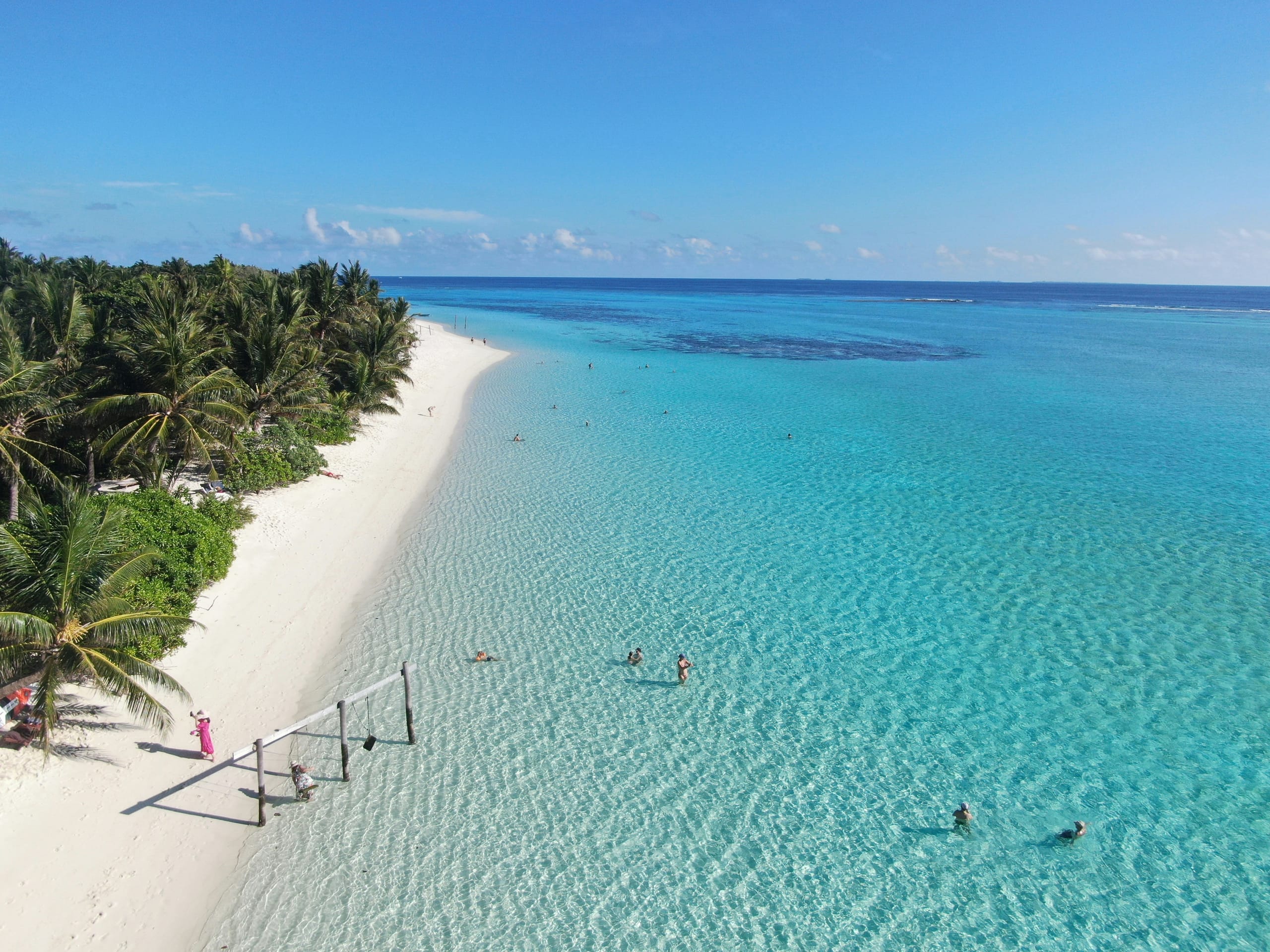
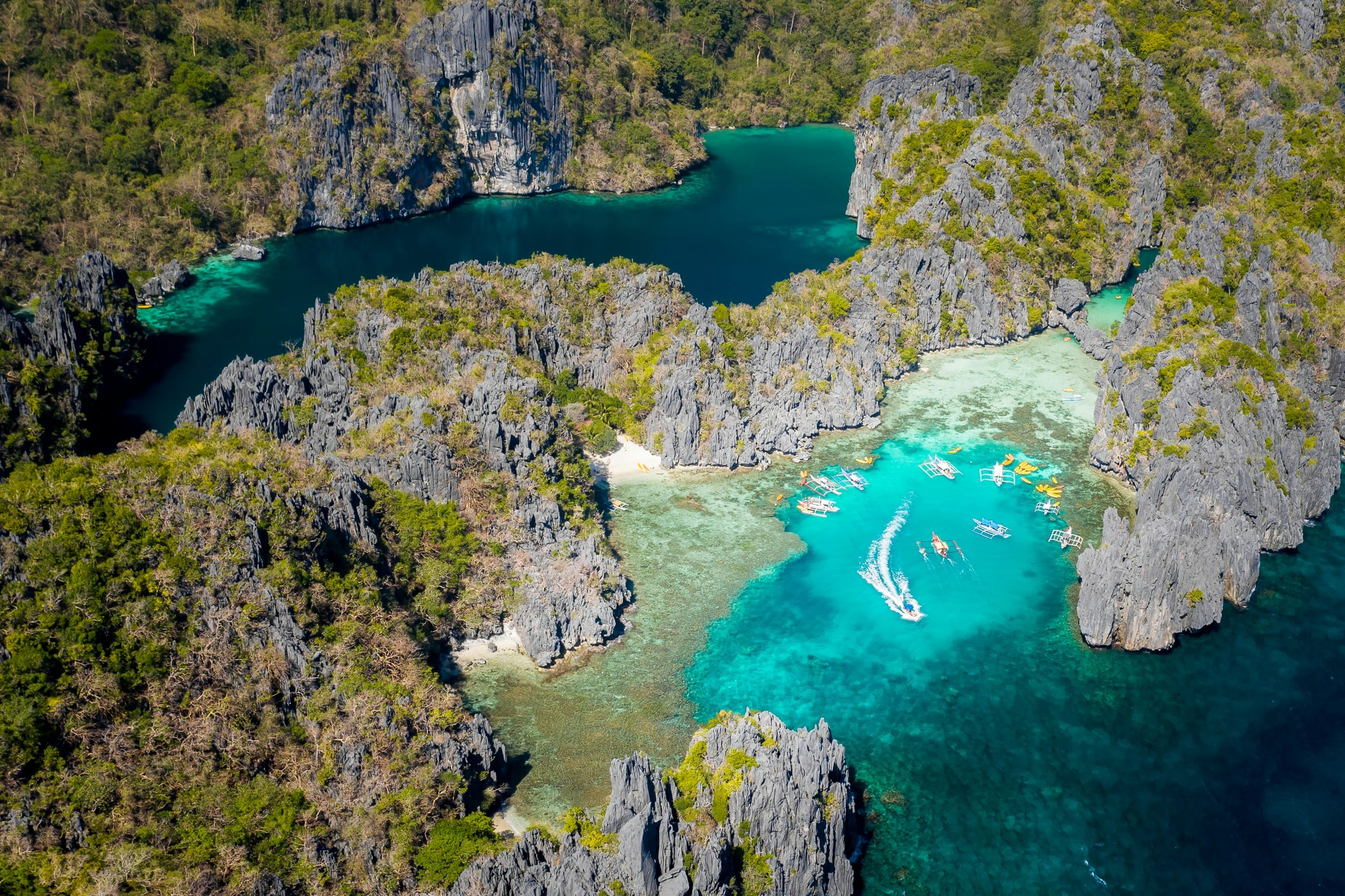
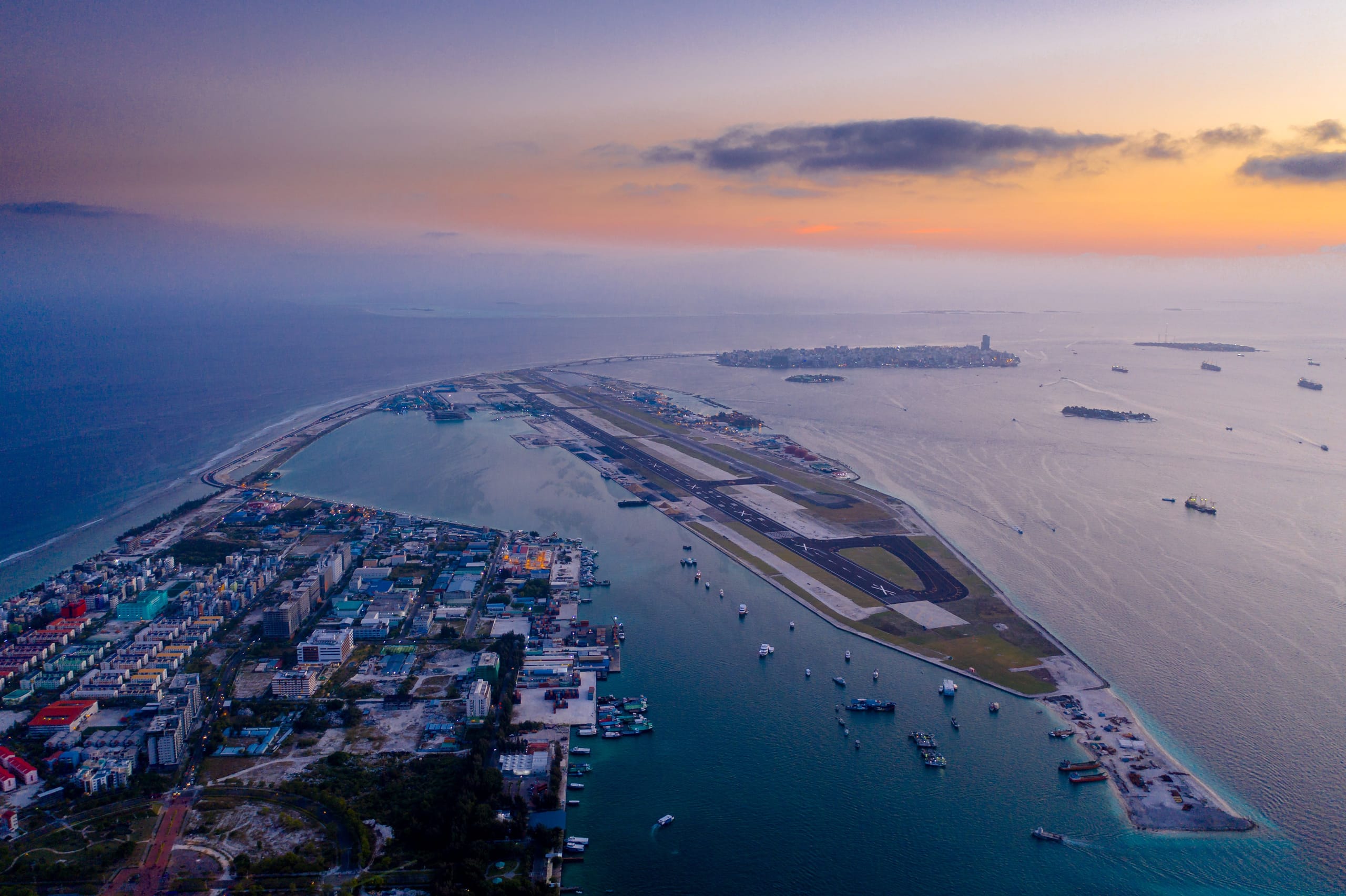
The generator behind the guesthouse changes pitch around seven, and that is how you know the island has switched over to evening. Sand streets still warm through your sandals. A cat asleep on a coil of blue rope. Somewhere behind the houses a television is on too loud, and out at the end of the harbor wall two men are hosing down a boat that came in late. There is no bar to walk into. There is no bar on the whole island. You have an evening with nothing scheduled inside it, and depending on the hour that is either the best thing about this place or the hardest.
Nobody arrives at this idea by accident. The country shows up in your head already decorated: two glasses on a deck, a drone shot pulling back over a lagoon, somebody's ring finger in soft focus. So you sit with the tab open and think that going by yourself would be a slightly odd thing to do here. Like booking a table for two and then asking them to take the other chair away.
It is not odd. It is just not the picture.
The country has been doing this for years without telling you
The Maldives sells one image and runs two economies. Resorts occupy their own islands, one lease each, and they are where the photographs come from. Then there are the inhabited islands, where Maldivians live and where a 2009 change to the rules ↗ let ordinary islands start taking guests. Nobody photographs those for a magazine. The second economy stayed invisible to almost everyone outside it.
It is not small anymore. Plenty of people now come to the honeymoon country to do something other than the honeymoon.
"Guesthouses accounted for 22.6 percent of tourist arrivals to the Maldives so far this year, reflecting the continued expansion of locally operated tourism accommodation."
944
guesthouses operating on inhabited islands
17,010
guesthouse beds, about a quarter of national capacity
274,687
guesthouse guests so far this year
179
resorts, for scale
"These include 179 resorts, 934 guesthouses, 173 safari vessels and 16 hotels."
So the first thing worth knowing is that you will not be an anomaly. On a guesthouse island midweek there are Italians on the jetty, a couple photographing a stingray in the shallows, two divers arguing about a compressor, and a woman who has been there eleven days and has stopped counting. The island is not staged for pairs. The brochure was.
The atoll you pick decides more of your trip than anything you book after it, and the place to start on that is the seasons and the geography, month by month.
The room is not where being alone costs you
This is the part everyone braces for and it is the smallest problem. A guesthouse room is sold as a room. One bed or two, one of you or two of you, the number on the door does not care. There are places that hold a single rate for a solo guest and places that do not.
"You may get the opportunity to share a room so the costs can be split rather than paying single supplement but remember once again the local island guest house prices are not like the resorts so you may be able to afford to book a single room on your budget."
Where the arithmetic does bite is the green tax, charged per person per night rather than per room, and a private transfer, charged per boat rather than by the seat the way a shared speedboat or a seaplane is. The room is a fixed cost you absorb and then stop thinking about. The water is where the solo penalty lives, and it is not a price. It is a headcount.
For the full shape of what a guesthouse week costs, including the ferry and speedboat arithmetic, the budget breakdown for this country does the whole sum.
Every good day here is a boat
Land in the Maldives is a rumor. The islands are small enough that you can walk the perimeter of most inhabited ones in under an hour, and once you have done that twice there is nothing left on land to find. Everything the country is good at happens offshore: reefs, sandbanks, channels where the current runs, a bay that fills with plankton and then fills with mantas.
Which means your day is not a decision about where to go. It is a question about whether a boat is going.
Guesthouse excursions are advertised per person and costed per boat. A captain has fuel to buy, a crew to pay, and a hull that costs the same to move whether it holds four people or fourteen. So the board at reception is not a schedule. It is a set of proposals. The sandbank trip goes at nine if enough people say yes by dinner the night before. Whale shark day goes if the numbers work. Divers pay per tank, which makes the economics different, so the dive boat goes.
You are not booking a day. You are joining one, or you are funding one.
This is the mechanical fact that separates traveling here alone from traveling here with somebody. A pair walks into reception already a third of the way to launching a boat. One person is one seat. Sometimes that seat is what tips a trip into going. Sometimes you are the only name on the sheet and the trip does not happen, and nobody announces that it did not happen, they just say maybe tomorrow.
There are two ways around that and neither is in most write-ups. The first is the scheduled small-group island trip: a departure that is already full before you arrive, running a fixed sequence of islands over a set number of days with a cap of somewhere between five and twenty people. You are not the name that tips it into going, because it is going.
The second is a liveaboard, which inverts the whole problem: the boat is the trip, so it sails every morning by definition, and the evening has a room with people in it rather than a still island and a locked cafe. Both cost more than a guesthouse week and both solve the exact thing this article has spent two sections describing.
The rules favor one person
Here is the part almost nobody writing about solo travel in this country has noticed. The best water in the Maldives is regulated by headcount, and every one of those caps is a cap on groups.
The South Ari Marine Protected Area, where whale sharks are seen year round, sits under a management plan that limits how many boats and how many bodies can be at one animal at one time. Four vessels maximum. Sixty people in the water in total, across all of them. Fifteen minutes each. One certified guide for every six guests, and the guides sit an exam to keep the certificate.
"For every 6 guests with the whale shark there must be a SAMPA registered guide."
"Each person can be with the whale shark in the water for no longer than 15 mins."
Highlight
The same shape holds at Hanifaru Bay in Baa Atoll, the plankton funnel where manta rays gather to feed. Visits inside the bay are tightly regulated, so check the current rules with a local operator before you go.
"The maximum time allowed for snorkeling with mantas is 45 minutes, and there are always rangers on site to ensure that these rules are followed."
The alert, and why it belongs to you
Hanifaru cannot be booked for a Tuesday at ten. The rangers and the island guides run a phone network and watch the bay, and when the mantas come in somebody calls it and the boats go. You get told to be ready. Ready means shorts on, mask in hand, no negotiation with anybody about whether they want to finish their coffee first.
A group of six talks it over. You are already on the jetty. Across a week of watching guesthouse boards fill and empty, that is the closest thing to an advantage that traveling by yourself hands you anywhere, and it exists here because the caps exist.
- 01
Ask what is running before you unpack
At check-in, ask which trips are going this week and which days already have names on them. You are not asking for a brochure. You are asking where the numbers already are.
- 02
Take the day that is already half full
The trip with four people signed up will go. The trip with nobody signed up needs you plus three strangers who have not arrived yet.
- 03
Say yes fast, and say it out loud
Reception is tracking a headcount in their head. Being a confirmed name at breakfast is worth more than being a maybe at lunch.
- 04
Keep one flexible day per island
Weather cancels boats, and the manta call comes when it comes. A schedule with no slack in it is a schedule that will lose you the one day that mattered.
- 05
Ask who holds the permit
Protected sites need a registered guide and a ticket bought through them. If the person selling you the trip cannot name the guide, you are buying a boat ride, not an entry.
The evening with no bar in it
Solo travel elsewhere runs on a piece of infrastructure you have probably never had to think about: the room with drinks in it. The hostel bar, the terrace, the place where you can sit down by yourself at seven and not be by yourself at eight. That building does not exist here.
"Alcoholic drinks are only available on resort islands. Do not take any alcohol out of your resort. You can be arrested and deported for possessing and drinking alcohol, or being intoxicated outside resorts and on inhabited islands."
It is not a soft rule and it is not enforced casually. Inhabited islands are dry, which means the social architecture a solo traveler leans on has been taken off the map, and nothing has been built to replace it in the same shape.
What has been built instead is a boat. On the bigger guesthouse islands there is a safari vessel moored offshore serving alcohol legally on the water, reachable by a tender that takes about three minutes, and the transfer is usually free because the drinks are where the money is. There is often karaoke, which is either a feature or a warning depending on your temperament.
"It can be accessed by a speedboat which only takes about 3 minutes. Entry free and transport with return is free, as you only have to pay for the beer, food, and services provided on the safari."
Worth doing once, mostly for the strangeness of it. It will not fill your evening though, because it runs on a boat schedule and because a karaoke deck is a hard place to have a conversation with somebody you have not met.
The answer to the evening is that the socializing has moved to the daytime. You meet people in the water and at breakfast, not at nine at night. Skip the boat and you skip the room where everyone got introduced, and then you eat by yourself and go to bed at half past nine, and the island is very still, and the stillness is far more total than you expected.
And there is a version of that for people who do not dive yet, which the page keeps implying and never says. An Open Water course is three or four days. What it buys, beyond the certificate, is precisely the two things this island is short of for one person: a boat that goes every morning regardless of who signed up, and the same four faces every day for most of a week.
If you were already half-considering it, the arithmetic on a solo trip here is better than it looks, because you are not paying for a course, you are paying for the structure of the week.
Some nights that is the best thing about the place. Some nights it is nine thirty and you are lying in the dark listening to a generator.
Both are true. Anybody who tells you only the first one is selling something.
Food, and the problem of one
Guesthouse kitchens cook for a table. Most places sell half board because it is the only way the arithmetic works on an island where every onion came in on a supply boat, and the food that comes out of that arrangement is good in a narrow way. Tuna, mostly. Breakfast is tuna in a coconut and chili mash you eat with flatbread. Lunch is tuna in a coconut curry. A clear tuna broth with lime and rice at dinner, which sounds thin and is not.
The narrowness is the thing to plan around. On a small island there might be one guesthouse kitchen and one cafe with four tables, and by day four you will have read the menu enough times to recite it. That lands harder on one person than on two, because a pair can be bored together and make a running joke of it. Alone, the fourth identical dinner is just the fourth identical dinner.
Breakfast is the meeting
If you take one piece of scheduling advice from this whole piece, take this one. Eat breakfast in the common room at the same time everybody else does, even if you are not hungry, even if you would rather read. That is where the day's boat gets assembled. Somebody says they are going to the sandbank and asks whether anyone else wants in. Miss it three days running and you will have a very restful, very solitary week, and you will not have seen a manta.
Short eats are the other move. The little fried and steamed snacks that sit under glass in island cafes cost almost nothing, and ordering three of them with a ginger tea at four in the afternoon is a legitimate way to sit somewhere public without committing to a meal.
What you wear, and the walk back through the village
Every guesthouse island has a designated stretch of beach where swimwear is allowed. Everywhere else on the island, including the rest of the shoreline, runs on local dress standards, and the advisory is specific about what that means.
"You should be sensitive to local dress standards when outside holiday resorts, including on beaches used by locals. Men and women should have shoulders covered, avoid short or tight-fitting shorts, have arms and upper legs covered when bathing."
The practical version for one person: you will be doing the walk from the beach back to your room by yourself, wet, carrying your own things, past houses where people live. Bring something with sleeves that goes on over a wet swimsuit without a fight. A long shirt you do not mind ruining does more work on this trip than anything else in the bag.
Nobody will be unkind about it. Maldivian islands are not confrontational places and the guesthouse staff will show you where the line is on day one. It is simply a small piece of daily admin that you handle by yourself, several times a day, and it adds up to a different rhythm than a resort week.
If your dates land in Ramadan
This is the one date check that can reshape an entire trip, and it moves every year because it follows the lunar calendar.
Check your dates against Ramadan before you book anything
The advisory puts the 2027 start at around 7 February, running 29 or 30 days. Outside resorts, eating, drinking and smoking in public during daylight is not done, and island cafes largely close in the daytime."In 2027, it may start on 7 February and last for 29 or 30 days. During this time, do not eat, drink or smoke in public in the daytime, outside of holiday resorts."
A guesthouse will still feed you. It happens indoors, out of view, sometimes in a room with the curtains pulled, and it feels stranger when you are the only person at the table. Boats still run. Everything else on the island shifts to after sunset, which is interesting to witness and difficult to be alone inside of, because the whole island is doing something communal that you are politely outside.
Go in Ramadan if the atmosphere is what you came for. Do not go in Ramadan if what you wanted was to sit in a cafe at lunchtime and watch the harbor.
What changes when there are two of you
It is a short list, which is the point. Most of the country is priced and organized per head, so most of it does not change at all.
Alone
- One room, absorbed whole, no way to halve it
- A private transfer does not divide, so the ferry timetable binds harder
- Boat days depend on other guests signing up
- The last seat on a capped excursion is usually yours
- Evenings are yours to fill, for better and worse
As a pair
- Same room, split two ways
- A private speedboat becomes reasonable on a shared bill
- You are already two names toward a boat launching
- A nearly full excursion cannot fit you both
- Evenings are solved before they start
| What changes | Alone | As a pair |
|---|---|---|
| Room | One room, absorbed whole, no way to halve it | Same room, split two ways |
| Transfers | A private transfer does not divide, so the ferry timetable binds harder | A private speedboat becomes reasonable on a shared bill |
| Boat days | Boat days depend on other guests signing up | You are already two names toward a boat launching |
| Excursions | The last seat on a capped excursion is usually yours | A nearly full excursion cannot fit you both |
| Evenings | Evenings are yours to fill, for better and worse | Evenings are solved before they start |
Notice that the excursion line runs the other way from the rest of them. That is not a rounding error. It is the structure of protected-area tourism in this country, and it is the one place where being one person is the stronger hand.
If the wider mechanics of building a trip around yourself are the part you are unsure about, the planning frame for a solo trip covers the structural side that applies anywhere.
The months, and the argument inside them
The dry season runs November through April. Seas settle, visibility opens up, rain stops being a daily event. It is also when the country is busiest, roughly December through April, so boats fill faster and guesthouses book out further ahead. For a solo traveler both halves of that matter, and they pull the same way: full boats go.
Then there is the other calendar. The manta aggregation at Hanifaru Bay follows the tide that pushes plankton into the bay, so ask a local operator which months are running.
"The season for manta rays is from May to November."
So the flattest water and the biggest animals are not in the same months. You do not get both, and any article that tells you one window is simply the best is ignoring one of the two. Pick which one you came for, then pick the month.
Air temperature stays between 75°F and 91°F (24°C to 33°C) year round, so warmth is never the reason to choose a month. Wind and plankton are.
Moving between islands with nobody to split with
The public ferry network is inexpensive and slow and built for Maldivians going about their week, not for visitors going about an itinerary. A crossing a speedboat does in forty minutes can take three hours. On many routes there is one sailing a day, and on Fridays much of the network does not run at all, because Friday is the congregational prayer day and the country's week is shaped around it. MTCC publishes the timetables at mtcc.mv and atolltransfer.com puts the same routes into something you can read on a phone.
Read them for the shape rather than the times, because the shape is the constraint: the network runs toward the capital in the morning and back outward in the afternoon, since it exists to get Maldivians to work and home again. That is why one island pairs with another as a day trip and the island next to it does not, and it is not a thing you can see from a map.
A pair splits a private speedboat and the timetable becomes optional. Alone it does not divide, so the timetable is the trip. That is not a disaster. It is a planning constraint to accept early, because the alternative is discovering it on the morning you needed to be somewhere.
There is an entry condition that lands hardest on exactly the reader this piece is written for. The 30-day visa on arrival is free and given to everybody, but it is given against a confirmed onward ticket and a prepaid booking at a registered guesthouse or hotel, plus enough money to cover the stay. The improviser who lands intending to work it out over breakfast is the one person at the desk without the paperwork. Book the first island before you fly, even if you plan to change everything after it.
"A complete travel itinerary, including confirmed return journey tickets, prepaid confirmed booking at a registered facility, and sufficient funds to cover the stay in the Maldives."
The arrival leg is its own separate puzzle with its own separate trap, and getting from the airport island to a guesthouse island works through the whole thing from the moment you land.
Two islands in ten days is a settled trip. Four is a logistics exercise you will run by yourself, with nobody to hold your bag while you go and ask about the boat.
A weekday alone on a guesthouse island
5:45 amCall to prayer
You wake up whether you meant to or not. Most people go back to sleep. It stops registering by about day three.
7:30 amBreakfast in the common room
Tuna and coconut, flatbread, instant coffee. This is where today's boat gets decided. Be in the room.
9:00 amThe boat, if it goes
Two reefs, a sandbank, lunch out of a cooler. You will talk to more people in six hours than in the previous two days.
3:30 pmBack, salt-crusted, useless
A shower, then the flat part of the afternoon. Nothing is open. Nothing needs to be.
5:50 pmThe jetty
Everybody ends up here at sunset without arranging it. Kids jumping off the concrete, somebody fixing a line, the light doing the thing it does.
7:30 pmDinner, then the island shuts
The cafe closes when the last table leaves. By nine thirty there is nobody outside except cats.
Safety, said plainly
The summary worth having is that the risk here is not people. Crime against visitors on guesthouse islands is unusual, the islands are tiny and everybody knows who you are within a day, and the advisory reserves its warnings for a specific geography.
"Crime levels are low in the exclusive resort islands, but petty crime does happen. Outside the resorts, there are incidents of gang-related violence including knife crime, mainly in Malé and in Hulhumalé. Avoid empty roads when on foot, particularly after dark."
That is the capital and the reclaimed island beside the airport, which is exactly where you are most likely to spend a night at the start or the end of the trip. Take it as an instruction about which streets to walk down at eleven at night, not as a reason to skip the city.
The water is the actual risk
Currents around these islands are strong enough to be a recurring cause of drowning, and the country's own excursion sites carry a specific hazard the advisory names outright.
"There have been fatal accidents involving boat propellers in the South Ari Marine Protected Area (SAMPA) and nearby whale shark tourism sites. Regulations requiring propeller guards are not yet fully enforced."
Which makes the whale shark day, the one everybody comes for, the day to be most deliberate. Enter the water on the side the guide tells you to enter it on. Surface where you can see hulls. If the boat has no guard on the propeller and it is sitting inside the protected area, that is worth noticing rather than shrugging at.
Diving carries its own version. There are three hyperbaric chambers in the country, and plenty of sites sit more than an hour from the nearest one. Ask your operator what their plan is. A good one answers immediately, because they have already thought about it.
- Send the day's plan to one person at home before you get on a boat, including which island and which operator.
- Take a dry bag with a charged phone on every excursion, not just the long ones.
- Check that the guide holds a certificate for the protected area, not just a boat.
- Do not swim off the end of an island by yourself because the water looks flat. It is a channel.
- Keep enough cash for a transfer you did not plan on. Card acceptance thins out fast away from the capital.
The FCDO's general guidance for people traveling by themselves contains one line worth more than the rest of the page put together.
"Remember that being safe is more important than being polite."
On a small island where everybody has been kind to you all week, that sentence is harder to act on than it sounds. It is still the right sentence.
If reading government advisories tends to leave you more anxious than informed, reading a travel advisory without spiraling is about how to weigh what they actually say.
The two things worth sorting before you fly
Insurance first, and specifically insurance that covers what this trip is made of. The failure modes here are not lost luggage. They are a cancelled crossing that strands you a day from your flight, a dive that goes wrong a long way from a chamber, and a stretch of weather where no boat goes out for three days.
Rolling monthly travel medical coverage is what a lot of independent travelers end up with. It stays active across borders and does not need an itinerary declared up front, which suits a trip whose shape keeps changing with the boat schedule.
Whichever policy you pick, read the water sports clause before you pay. what a travel policy covers and what it quietly does not goes through what the exclusions mean in practice.
Second is data, which matters more here than in most places because everything you need to check is a schedule. Ferry times, the weather, the message from reception saying the boat is going at eight instead of nine. Coverage is solid in the capital and on the larger inhabited islands and gets patchy on the small ones.
A travel eSIM covers the country and installs before you leave home, which is the version of this that works. The alternative is standing at an airport counter at midnight negotiating for a SIM in a language you do not have.
If you have never used one and are not certain it will work on your handset, how an eSIM differs from a plastic one is the short version of that decision.
Money is the smaller item, with one detail that only bites the person traveling alone. Guesthouses and dive centers take cards, island cafes and ferry counters often do not, and the exchange you get at an airport counter is not the exchange you get from a decent multi-currency account.
Bring the emergency dollars in clean notes. Banks and counters here are particular about condition and a torn or heavily marked bill gets handed back, which is a shrug when somebody else has a wallet too and a problem when nobody does. the way card fees eat a budget is the part most people fix after a trip instead of before it.
The mistakes that belong specifically to going alone
Most of what goes wrong on a solo trip here is not dramatic. It is a week that ends up smaller than it should have been, and it usually traces back to one of four decisions made on the first day.
- Booking four islands because the map made them look close. The ferry timetable disagrees, and you will spend the trip in transit with your bag.
- Skipping the group excursion to save money, then finding there is nothing else to do and nobody to do it with.
- Landing on a Friday with an onward ferry assumed rather than confirmed.
- Treating the guesthouse owner as a receptionist rather than as the person who decides whether your boat goes.
Pros of going to the Maldives on your own
- The island is small and safe enough that you never handle logistics after dark
- Capped excursions have room for one when they have no room for a group
- Guesthouse breakfast throws you into company whether you planned it or not
- Nothing here needs a second person to be worth doing, including the water
- The pace is slow enough that being by yourself stops feeling like a condition
Cons of going to the Maldives on your own
- The room rate does not split and neither does a private transfer
- No bar means no default place to meet anybody after about eight
- Boat days can be cancelled by a headcount you have no control over
- Food variety on a small island runs out faster when nobody is sharing plates
- Evenings are long, and on a rough-weather day they are very long
How long, and what it should look like
Seven to ten nights is the shape that works. Under a week and the transfers eat too much of it, because getting from the airport to an island and back is most of two days no matter how you do it. Past two weeks on guesthouse islands the sameness starts to weigh, unless you dive, in which case the sameness is the point and you will happily stay a month.
Two islands. One busy enough to have several boats going out and a dive center that runs regardless of numbers, and one small enough that you learn the whole place in an afternoon. For the first, Maafushi is the obvious one: two main roads, a bikini beach at one end, and more kitchens than the rest of the atoll put together. Rasdhoo is the diver's version of the same job, small and organized around the boats, with hammerheads off the corner at dawn.
For the second, Ukulhas walks end to end and keeps a beach on the north tip that people stay for, and Thoddoo grows the watermelon and papaya its kitchens cook that morning. Do the busy one first, while you are still working out how any of this operates, then go somewhere with four tables and no plan. the Maldives guide carries the rest of the list, with what each one is for.
Worth having open while you plan
FCDO Maldives travel advice
Entry rules, local laws, and the safety pages quoted throughout this piece. Updated regularly.
IMUGA Traveller Declaration
The arrival declaration every visitor files before landing. It has a submission window, so do not file it too early.
Maldives Immigration, tourist visa
Official conditions for the visa issued on arrival, including proof of onward travel and booked accommodation.
SAMPA whale shark guidelines
Vessel and swimmer caps, guide ratios, and distance rules for the protected area. Useful for judging an operator.
The part nobody puts in the brochure
Around day five something changes. It is hard to describe without sounding sentimental. The island stops being a place you are visiting and becomes a place with a routine you have joined. The man at the cafe starts making your tea before you order. You know which house has the loud television, and you know the tide well enough to guess whether the sandbank will be above water at two.
None of that requires another person. Some of it is easier without one, because you notice more when you are not talking.
And then there is a Thursday where the wind is up, the boat does not go, the cafe is shut between meals, and you sit on a wall for four hours watching a crab and thinking about how far you are from everybody you know. That day is part of the trip too. It is not a failure of planning. It is what a small island in the middle of an ocean is like when the weather says no.
You came for the water. You will remember the evenings.
The country will not make being alone here feel special, which is exactly the right thing about it. Nobody hands you a table for one with a flourish. You get a room, a boat if the boat goes, a plate of the same tuna, and a horizon with nothing on it in any direction. What you do with the space is not the island's problem.